


By Craig Birch, Technology Evangelist/Principal Security Engineer
The AGPM end of life is set for April 2026, leaving Group Policy management unsupported and unpatched. Cayosoft modernizes Group Policy governance by combining controlled administrative access, continuous change visibility, setting‑level rollback, and rapid recovery. Together, Cayosoft Administrator and Cayosoft Guardian help organizations reduce security, operational, and compliance risk after AGPM without relying on unsupported tooling.
As organizations continue modernizing their IT infrastructure, legacy management tools are gradually being phased out in favor of more scalable, cloud‑centric solutions. One tool reaching its end of life is Microsoft Advanced Group Policy Management (AGPM).
Long valued for extending the capabilities of the Group Policy Management Console (GPMC), AGPM has provided organizations with robust change control, versioning, and workflow capabilities for managing Group Policy Objects (GPOs). Delivered as part of the Microsoft Desktop Optimization Pack (MDOP) for Software Assurance, AGPM has played a critical role in maintaining secure and compliant on‑premises environments.
Microsoft has officially scheduled AGPM end of life for April 2026, signaling a significant shift for organizations that still rely on it for their Group Policy governance. With its retirement approaching, IT teams must begin planning now.
In this blog, we’ll break down how Cayosoft’s solutions are uniquely positioned to help organizations reduce security, operational and compliance risks, without relying on unsupported tooling.
Cayosoft Solves Typical AGPM Business Tasks
| Capability | AGPM | Cayosoft |
| Track Group Policy changes | Tracks GPO changes with version history | Tracks GPO changes with full change visibility |
| Centralized change history | Maintains historical versions of GPOs | Maintains centralized change history of GPOs for audit and recovery |
| Rollback of GPO changes | Can roll back to previous GPO versions | Can roll back GPO settings to a known good state |
| Recovery of deleted GPOs | Supports restoring deleted GPOs | Supports restoring deleted GPOs |
| Audit trail for changes | Provides basic audit trail | Provides detailed audit of who, what, and when |
| Focus on Group Policy control | Governance of GPO lifecycle | Control of who can make GPO changes |
How Cayosoft improves on AGPM
| Area | AGPM | Cayosoft advantage |
| Product lifecycle | AGPM end of life in April 2026 | Actively developed and supported |
| Change detection | Relies on controlled workflows | Continuous monitoring of live Group Policy changes |
| Response to attacks | No native attack awareness | Detects risky or unauthorized GPO changes |
| Speed of recovery | Manual rollback workflows | Rapid rollback and recovery during incidents |
| Delegation control | Static role separation | Enforced delegation using restricted groups |
| Approval enforcement | Pre‑change approval only | Just‑in‑time approval with enforcement |
| Protection of admin groups | Not protected | Protected delegation groups with automatic rollback |
| Unauthorized change handling | Logged after the fact | Automatically rolled back if change is unapproved |
| Automation compatibility | Limited | Designed for automation and modern IT operations |
| Security posture | Operational governance | Preventive security with enforcement and recovery |
The Security Risks of Unsupported GPO Tooling
After April 2026, AGPM will no longer receive security updates, bug fixes, or vendor support. This introduces significant security and operational risk because Group Policy directly controls authentication, authorization, and security configuration across the environment.
- No security updates or vendor support after April 2026 (due to AGPM end of life)
- Increased exposure to Active Directory attacks targeting Group Policy
- Permanent risk from unpatched vulnerabilities
- Unsupported interaction with Tier 0 assets
- Higher audit and risk review findings
- Reduced confidence and longer recovery during incidents
- Governance and compliance gaps for security‑enforcing systems
How Cayosoft Supports Modern Group Policy Management
Cayosoft modernizes Group Policy management by combining governed administrative access with continuous visibility, enforcement, and recovery. This approach aligns with how Active Directory actually works today, where changes occur through multiple tools, automation, and administrative paths.
Governance before change, recovery after change
Cayosoft enforces governance at the point where it is most effective, before access is granted.
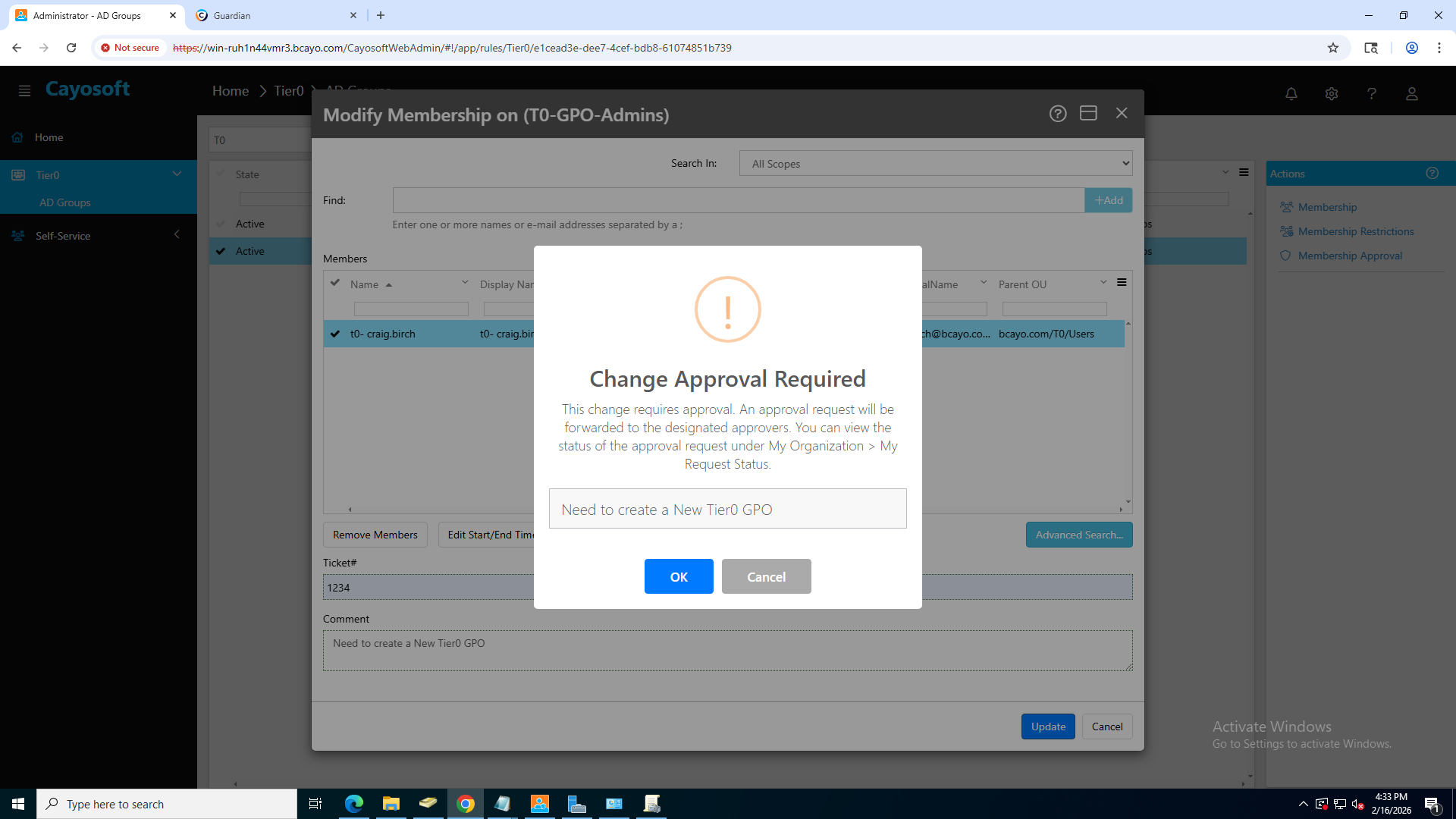
Cayosoft Administrator controls who is allowed to manage Group Policy by governing membership in delegated GPO administrative groups. Access is approved, time bound, and fully audited, ensuring that only the right administrators can create, modify, or link Group Policy objects within their assigned scope.
This enforces least privilege and just in time access without changing how Group Policy behaves once access is granted.
Governance before change: Cayosoft Administrator controls access to Group Policy management through approved, time‑bound group membership.
Change Visibility and Tracking
Once access is granted, Active Directory applies Group Policy changes immediately by design. Cayosoft Guardian complements Administrator by providing continuous visibility into all Group Policy activity.
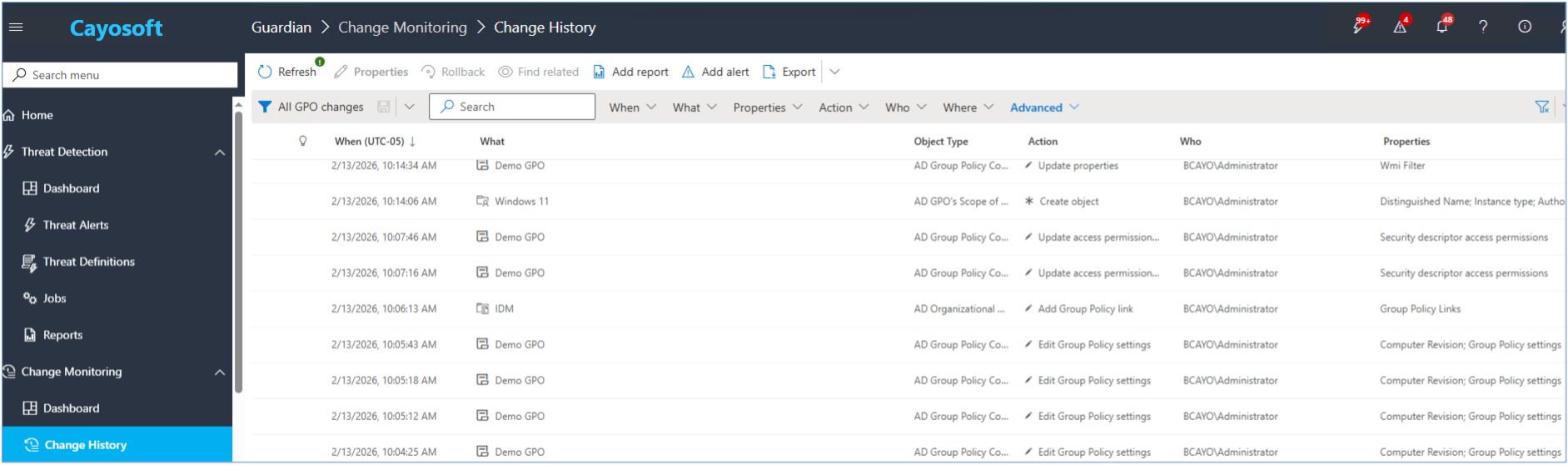
Guardian tracks what changed, who made the change, and when it occurred, allowing administrators and security teams to quickly identify unexpected or risky modifications without slowing down daily operations.
Group Policy change monitoring in Cayosoft Guardian
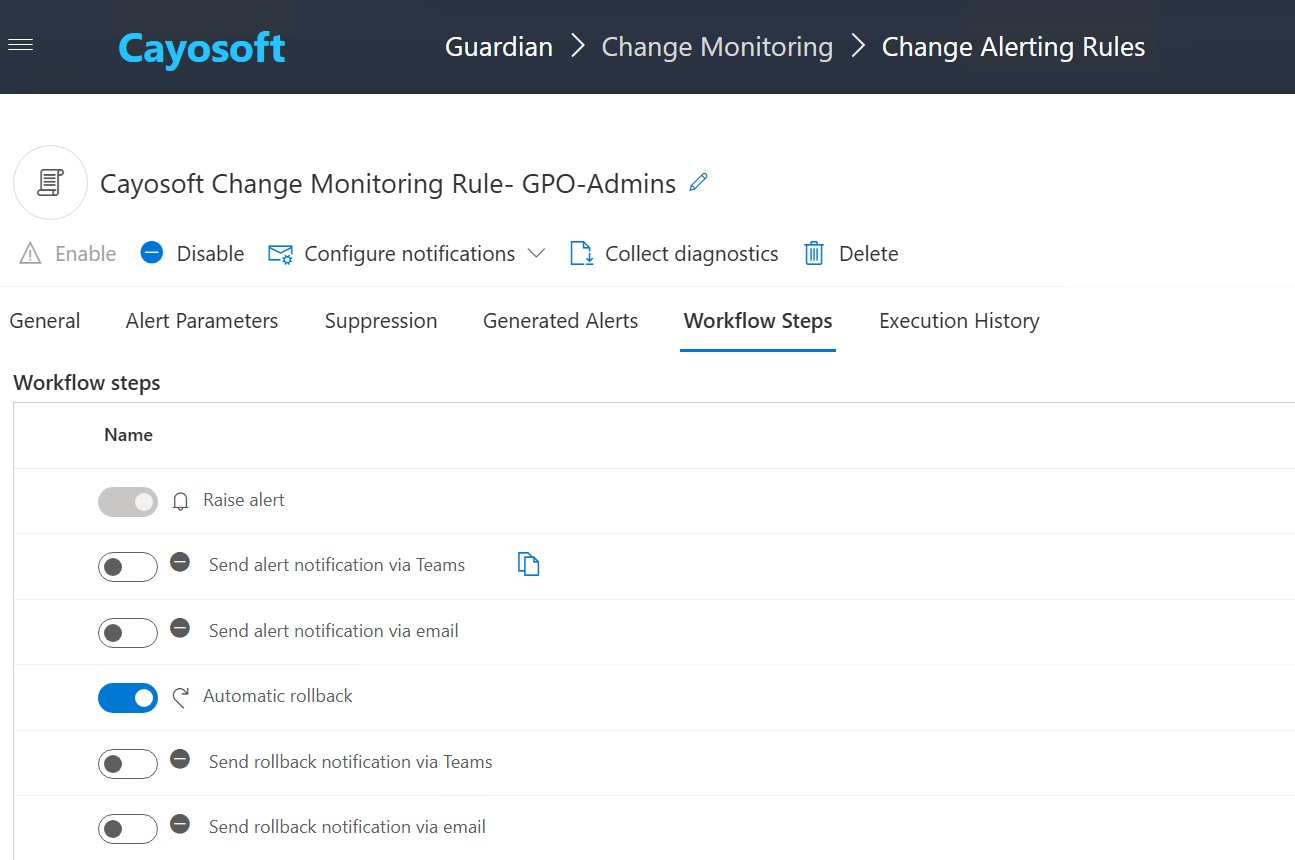
Guardian can also protect critical Group Policy delegation groups, such as t0gpoadmins. Any membership or permission change that does not originate from an approved account, such as the Cayosoft Administrator service account or a designated built in Administrator account, is automatically rolled back. This prevents unauthorized privilege expansion and enforces delegation boundaries even when changes are attempted outside approved paths.
Cayosoft Guardian Auto rollback of Protected Groups (GPO-Admins)
Group Policy Setting Details Before and After in Cayosoft Guardian
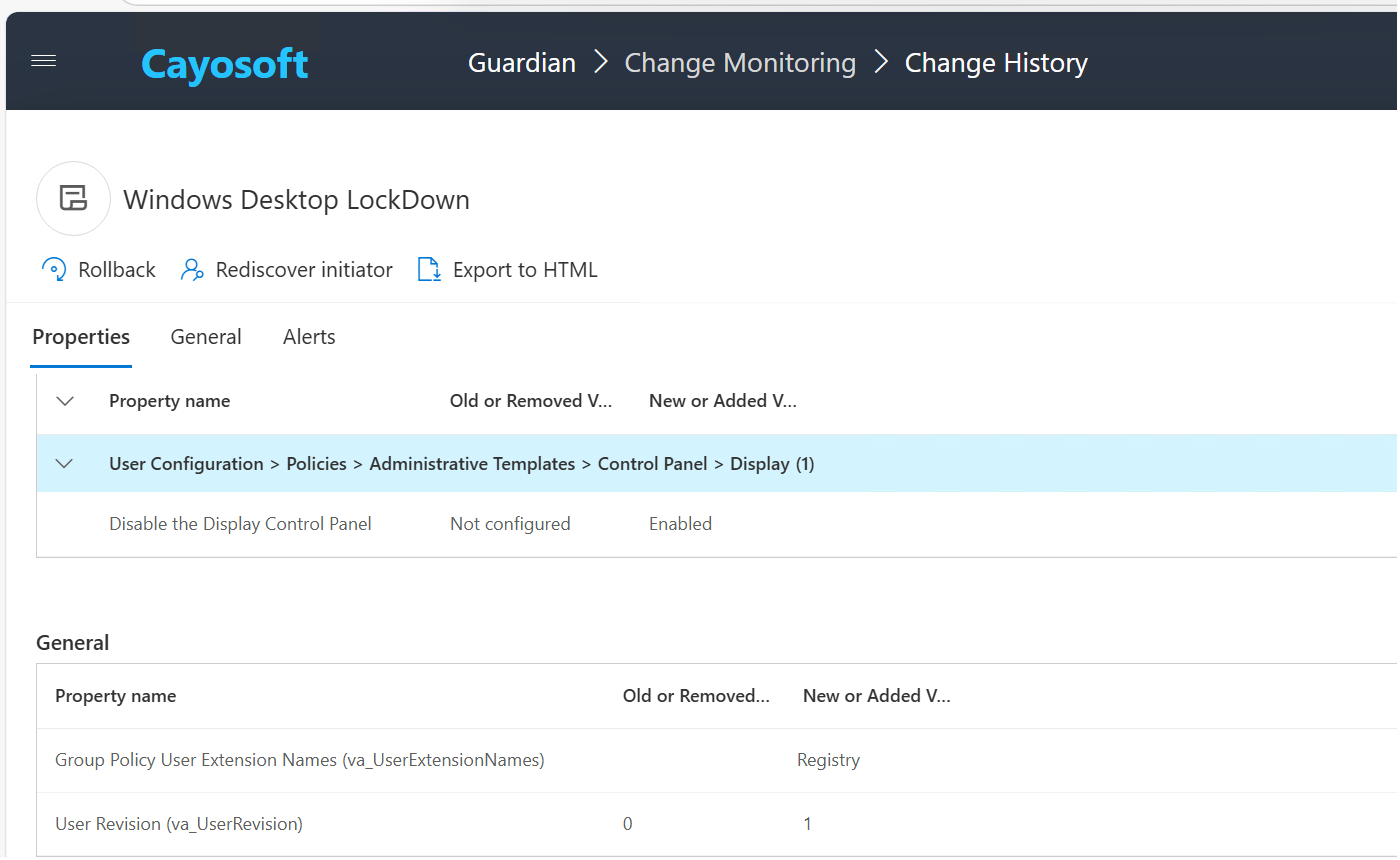
Centralized History for Recovery
Guardian maintains change history that supports rollback and recovery scenarios. Administrators can respond quickly to configuration drift, mistakes, or malicious modifications without relying on unsupported tools.
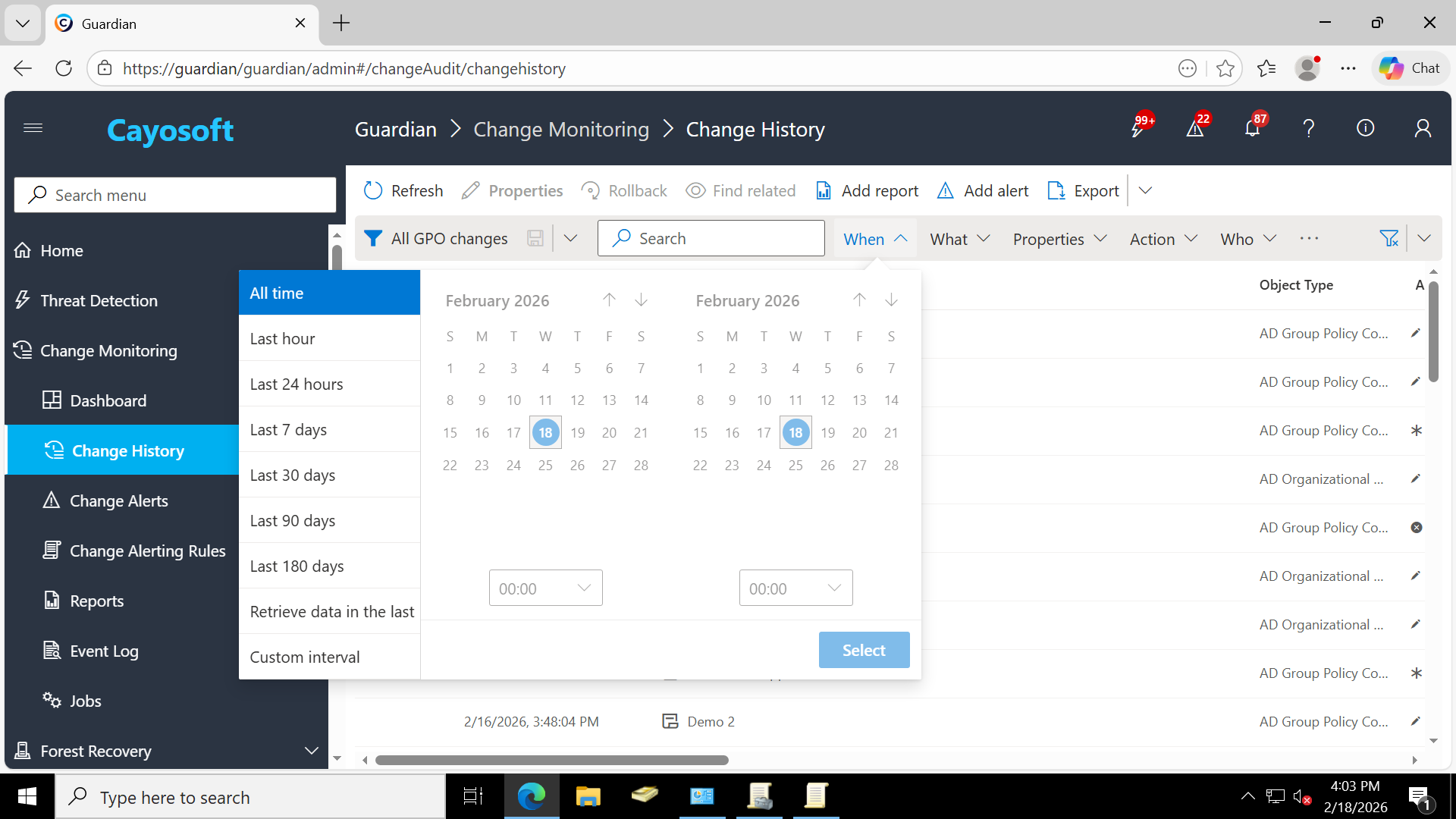
Rollback and GPO Recovery
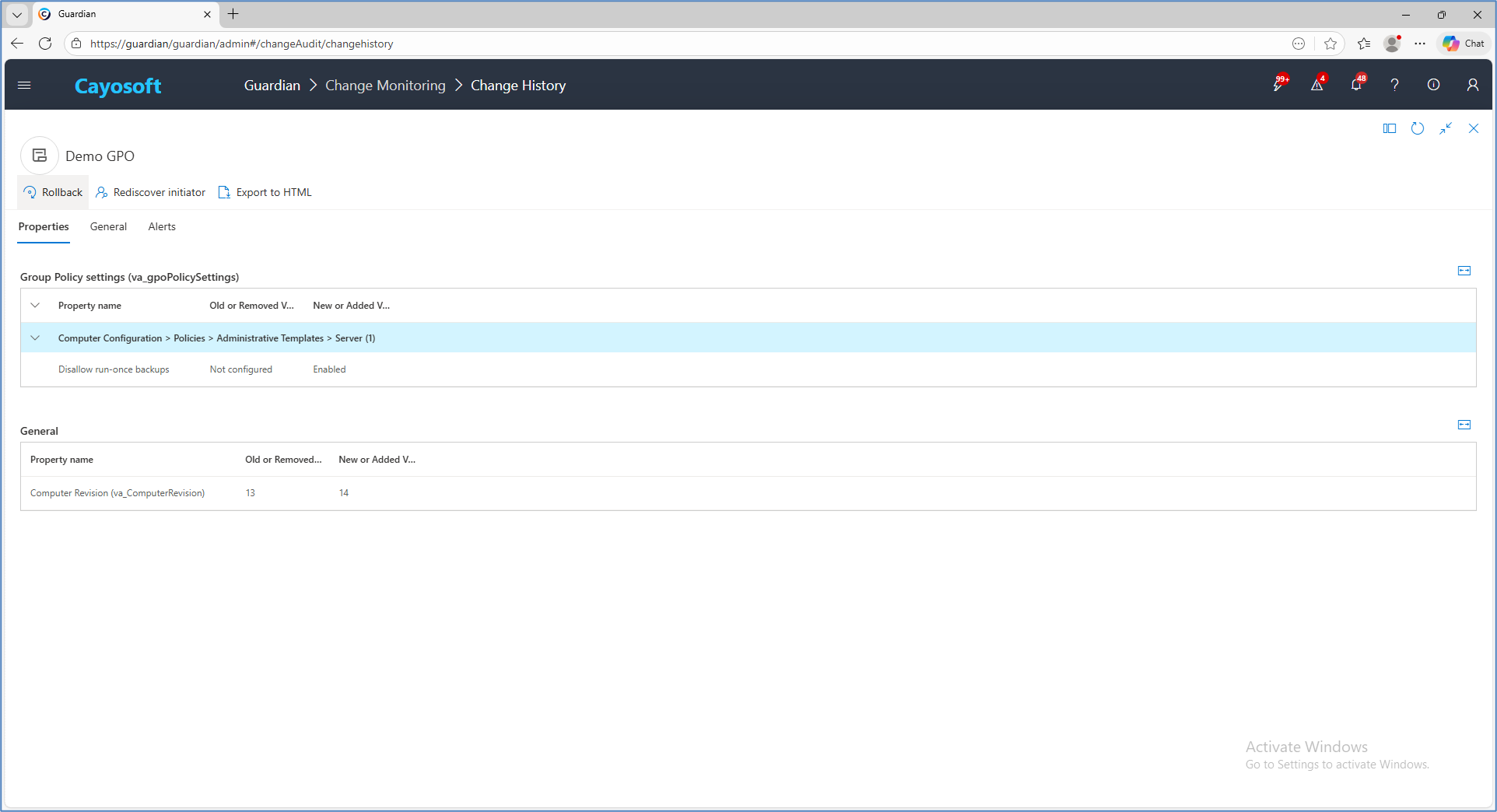
Guardian supports rolling back GPO settings and recovering deleted Group Policy objects. These capabilities are essential during security incidents and operational outages where speed and accuracy matter.
Group Policy rollback and recovery in Cayosoft Guardian
Detection and Response Focus
While AGPM emphasized controlling how changes were made, Guardian focuses on detecting changes, responding to them, and restoring known good configurations when necessary.
Built for modern Active Directory operations
Cayosoft is designed for environments that rely on automation, scripting, and scale. Rather than enforcing rigid editing workflows, Cayosoft prioritizes visibility, enforcement, and recovery, providing operational simplicity while keeping Group Policy under control.
Group Policy does not exist in isolation. Cayosoft fits into a broader identity resilience strategy, where visibility, control, and recovery across Active Directory help organizations detect issues earlier, respond faster, and recover with confidence.
In practical terms, Cayosoft helps organizations manage the impact of Group Policy changes, whether they are accidental, automated, or malicious.
Who Should Consider Cayosoft as an AGPM Replacement
Cayosoft is well suited for organizations that are retiring AGPM due to AGPM end of life constraints and still require strong control, visibility, and recovery for Group Policy.
It is particularly relevant for teams that want to reduce risk from Active Directory attacks and misconfiguration, enforce least privilege and just‑in‑time access for Group Policy administration, and recover quickly when changes cause outages or security issues.
For organizations that require approval and governance before changes, Cayosoft Administrator governs who is allowed to manage Group Policy through approved, time‑bound access. Cayosoft Guardian complements this by monitoring changes continuously and providing rapid rollback and recovery when needed.
Together, Cayosoft delivers end‑to‑end Group Policy governance that aligns with modern Active Directory operations.
Conclusion: Moving Forward After AGPM End of Life
AGPM reflected an era where preventing bad changes through rigid workflows was the primary objective of Group Policy governance. Today’s Active Directory environments require a more resilient and adaptive approach.
Cayosoft modernizes Group Policy management by combining governed access before change, continuous visibility during change, and rapid enforcement and recovery after change. This approach aligns with how Group Policy actually behaves in production environments.
As April 2026 approaches, AGPM end of life becomes more than a tooling decision. It becomes a security and risk decision.
The question is no longer how to stop every change. The real question is how effectively your organization can control access, detect issues, and recover when Group Policy changes occur.
That is where Cayosoft fits.
FAQs
Microsoft Advanced Group Policy Management (AGPM) is a legacy tool, delivered as part of the Microsoft Desktop Optimization Pack (MDOP), that extends the Group Policy Management Console (GPMC). It provides organizations with change control, versioning, and workflow capabilities to manage Group Policy Objects (GPOs) securely. However, with the AGPM end of life scheduled for April 2026, it is officially being phased out.
Yes, but only for a limited time. Microsoft has officially scheduled the AGPM end of life for April 2026. After this date, the tool will no longer receive security updates, bug fixes, or vendor support, introducing significant security risks to Active Directory environments.
While Microsoft is shifting toward cloud-centric solutions, Cayosoft provides a modern replacement for organizations facing the AGPM end of life. Cayosoft Administrator and Cayosoft Guardian modernize GPO governance by offering continuous change visibility, just-in-time administrative access, and rapid recovery capabilities that exceed the original features of AGPM.
Once the AGPM end of life date passes in April 2026, organizations will face several critical risks:
- Permanent Vulnerabilities: No more security updates or patches will be released.
- Increased Attack Surface: Exposure to Active Directory attacks targeting Group Policy will increase.
- Compliance Gaps: Using unsupported tooling for security-enforcing systems can lead to higher audit findings.
In anticipation of the AGPM end of life, Cayosoft offers several key advantages over the legacy tool:
- Continuous Monitoring: Unlike AGPM, which relies on controlled workflows, Cayosoft provides continuous visibility into live GPO changes.
- Automatic Rollback: Cayosoft can automatically roll back unauthorized changes to protected groups, whereas AGPM only logged them after the fact.
- Attack Awareness: Cayosoft is designed to detect risky or malicious modifications, a feature not natively available in AGPM.
See Cayosoft in Action
Cayosoft is recognized by Gartner as an ITDR solution provider and provides solutions that make identities more resilient to attacks and guarantee a fast forest recovery, if needed. Learn how Cayosoft Guardian facilitates granular change tracking, post-breach analysis, and long-term AD security improvements. Schedule a demo to see the capabilities in depth.