



Use CasesRecover
Recover Active Directory Before Downtime Becomes a Business Crisis
Cayosoft Guardian Instant Forest Recovery restores identity operations in minutes with a clean, validated standby AD forest.
“We chose Cayosoft because it was the only solution that gave us confidence we could restore Active Directory quickly, cleanly, and without rebuilding under pressure. In a federal environment, recovery in hours or days is failure. We needed recovery in minutes.”“
— IRS Identity Infrastructure Architect
Why Minutes Matter in Active Directory Forest Recovery
Active Directory is not just infrastructure. It is the control plane for business access.
When Active Directory fails, the business stops. Users cannot log in. Applications cannot authenticate. Backup systems, security tools, cloud services, and revenue-generating operations can all become inaccessible.
IBM reports the global average cost of a data breach at $4.4 million, and Verizon’s 2026 Data Breach Investigation Report says ransomware appears in 48% of breaches. Faster containment and recovery directly affect financial exposure, operational continuity, and customer trust. (IBM)
Traditional AD recovery is too slow for modern ransomware and destructive identity attacks. Paradigm Technica found legacy AD recovery models suffer from unvalidated backups, incomplete testing, all-or-nothing restore processes, and manual procedures that can take days to weeks.
The Business Impact of Slow AD Recovery: Estimated Cost of Identity Outage
Industry studies estimate the average cost of enterprise IT downtime between $100,000 and $540,000 per hour, depending on company size and sector.
Downtime Duration | Estimated Cost Range | Impact with Cayosoft | Impact of Traditional Backup & Restore |
1 hour | $100K – $540K | Identity restored in minutes with standby forest cutover. Recovery Time Objective (RTO) and Recovery Point Objective (RPO) are near zero. | Backup restore initiated; recovery process still underway. |
4 hours | $400K – $2.1M | N/A: AD restored in minutes | Identity infrastructure is still being rebuilt manually |
8 hours | $800K – $4.3M | N/A: AD restored in minutes | Extended troubleshooting of replication, DNS, or SYSVOL issues |
24 hours | $2.4M – $13M+ | N/A: AD restored in minutes | Possible outcome if a full forest rebuild is required |
Cayosoft Automates Instant Forest Recovery: Recover Clean. Not Just Fast.
Fast recovery is not enough if you restore the attacker with it.
Cayosoft Guardian Instant Forest Recovery pre-recovers only essential AD components into an isolated cloud environment using clean, patched VMs. During recovery, teams power on the pre-staged servers, validate the environment, and route identity operations to the recovered forest.
That means:
- Clean Active Directory forest recovery
- Daily automated validation
- No reliance on infected domain controllers
- Reduced reinfection risk
- Recovery independent of damaged on-prem infrastructure
- Controlled cutover instead of crisis rebuild
“The ability to cut over to a clean Active Directory forest in minutes fundamentally changed our disaster recovery posture. That confidence matters during a real incident.”
— Enterprise Identity Architect, Broward Health
| Recovery Factor | Cayosoft Clean Recovery Environment | Unclean / Compromised Recovery Environment |
| Malware Reinfection Risk | Recovery environment is isolated, validated, and scanned before cutover, reducing reinfection risk. | Backdoors, persistence mechanisms, and compromised configurations may be restored directly into production. |
| Recovery Confidence | Teams know the standby forest has already been validated and tested. | Recovery becomes uncertain. Teams may not know if backups are usable until restoration begins. |
| Recovery Time | Controlled cutover to a pre-built standby forest restores AD operations in minutes. | IT teams spend hours or days troubleshooting failed restores, corrupted backups, or compromised infrastructure. |
| Business Downtime | Minimal operational interruption and faster restoration of authentication services. | Extended outages disrupt users, applications, revenue operations, suppliers, and customer access. |
| Security Exposure | Threat detection and validation help ensure the recovered Active Directory is trustworthy before activation. | Attackers may retain persistence, privileged access, or hidden footholds after recovery. |
| Operational Complexity | Automated orchestration simplifies workflows for DNS, SYSVOL, FSMO, replication, and forest recovery. | Manual rebuilds require complex runbooks, scripting, and infrastructure reconstruction under pressure. |
| Compliance & Audit Readiness | Recovery workflows are documented, repeatable, and aligned to regulatory continuity requirements. | Failed or incomplete recovery may expose organizations to audit findings, reporting failures, or compliance violations. |
| IT Team Stress & Human Error | Recovery becomes a predictable operational process with less manual intervention. | Crisis-driven recovery increases the risk of mistakes, misconfigurations, and recovery failures. |
| Infrastructure Dependency | The standby recovery environment operates independently of the compromised production infrastructure. | Recovery may depend on damaged domain controllers, DNS, backup servers, or encrypted management systems. |
| User & Customer Trust | Faster, cleaner recovery helps maintain confidence in IT and security operations. | Prolonged outages and repeated reinfection events damage credibility and business trust. |
| Financial Impact | Downtime and recovery costs are dramatically reduced through rapid restoration. | Every additional hour of downtime increases operational loss, labor cost, and potential revenue impact. |
| Recovery Validation | Standby forests are continuously tested and validated before a disaster occurs. | Many organizations discover backup failures only during an actual outage. |
| Attack Surface During Recovery | An isolated recovery environment limits attacker access during restoration. | Attackers may still have visibility or control over parts of the production environment during recovery. |
| Scalability in Hybrid Environments | Designed for hybrid, multi-domain, and cloud-connected Microsoft identity environments. | Legacy recovery approaches often struggle with hybrid complexity and fragmented infrastructure. |
| Executive Assurance | Recovery readiness can be demonstrated before a crisis occurs. | Leadership may operate under a false assumption that backups guarantee recoverability. |
Customer Story: Recovery in the Real World
1-Click Rollback
Identity changes that once required days of investigation can now be reversed in seconds.
ACG Restores Control of Hybrid Identity Operations
Read the Case Study ›
h2
Title
text
Title
- listitem
- listitem
- listitem
- listitem
- listitem
Title
text
Title
- listitem
- listitem
- listitem
- listitem
- listitem
Title
text
Title
- listitem
- listitem
- listitem
- listitem
- listitem
Title
text
Title
- listitem
- listitem
- listitem
- listitem
- listitem
Title
text
Title
- listitem
- listitem
- listitem
- listitem
- listitem
What Cayosoft Delivers
Recovery Before Failure
Cayosoft pre-recovers AD before disaster strikes, so recovery is not a manual rebuild under pressure.
Minutes, Not Days
Cut over to a validated standby forest and restore identity services in minutes.
Clean Recovery
Recover in an isolated environment designed to reduce the risk of reinfection.
Daily Validation
Know the recovery environment works before you need it.
Unified Identity Resilience
Monitor, detect, roll back, and recover AD, Entra ID, Microsoft 365, Intune, and Teams from one platform.
h2
text
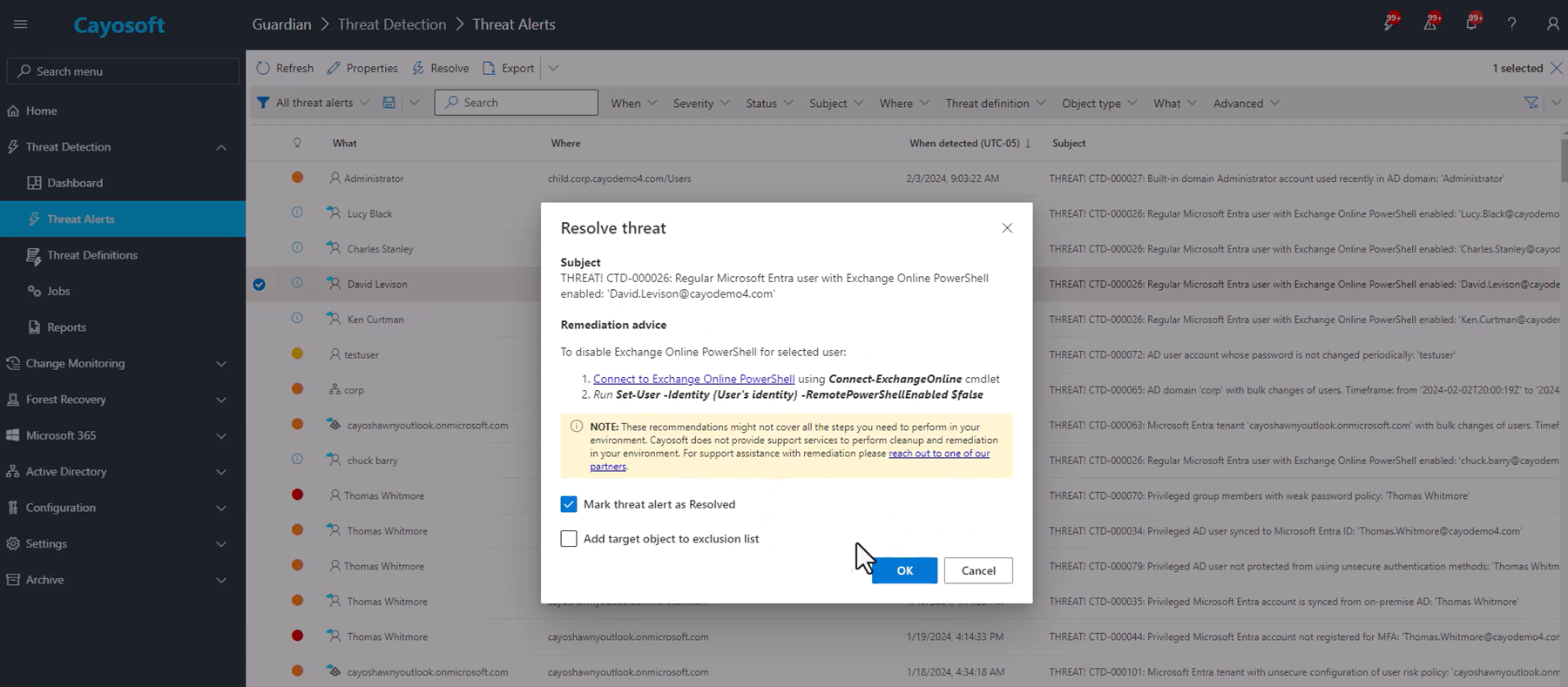
Control Your Entire Microsoft Identity Environment
Active Directory|Entra ID|Microsoft 365|Intune
Detect threats, reverse unwanted changes, and recover Active Directory in minutes.
Cayosoft Enterprise Suite


FAQ
Executive & Leadership FAQ
Active Directory is the authentication and authorization backbone for most Microsoft environments. When AD becomes unavailable, users cannot log in, applications cannot authenticate, VPN access can fail, Microsoft 365 services may become inaccessible, and critical operational systems stop functioning.
Modern organizations depend on identity to operate. If identity fails, business operations fail with it. According to the use case document, even a one-hour outage can cost enterprises between $100,000 and $540,000, depending on company size and industry.
Traditional backup approaches were designed for infrastructure recovery, not modern identity attacks. They often require manual rebuilding of domain controllers, DNS, SYSVOL, FSMO roles, replication topology, and other dependencies during an active crisis.
More importantly, traditional backups may restore compromised identity state, including attacker persistence, backdoors, unauthorized privilege escalation, or corrupted configurations. Paradigm Technica found that legacy AD recovery procedures can take days or weeks and frequently rely on untested recovery plans.
Recovering from an unclean environment risks reintroducing attackers directly into production. Malware persistence, compromised accounts, malicious Group Policy changes, and hidden privilege escalation may survive restoration.
The use case document compares clean versus compromised recovery environments and shows how unclean recovery dramatically increases reinfection risk, downtime, operational uncertainty, audit exposure, and financial impact.
Cayosoft Guardian Instant Forest Recovery maintains a continuously validated standby Active Directory forest in an isolated cloud environment. Instead of rebuilding AD during an outage, organizations perform a controlled cutover to a clean standby forest prepared before the incident.
Paradigm Technica found Cayosoft reduced catastrophic recovery time from days or weeks to approximately one hour.
Every additional hour of identity downtime increases operational disruption, lost productivity, customer impact, compliance exposure, and recovery cost.
Paradigm Technica estimated downtime costs at approximately $750,000 per hour for a 10,000-employee enterprise and modeled manual Active Directory recovery costs exceeding $500 million during a catastrophic event.
Cayosoft takes a “shift-left” approach to recovery by preparing for it before failure occurs. The platform continuously validates recovery readiness, monitors for threats, enables rollback of unwanted changes, and maintains an isolated standby forest independent from compromised infrastructure.
This approach helps organizations:
- Reduce ransomware recovery time
- Avoid restoring compromised identity state
- Demonstrate recovery readiness
- Align with business continuity and disaster recovery mandates
- Improve operational resilience
Yes. Cayosoft provides:
- Repeatable recovery workflows
- Immutable change tracking
- Audit-ready reporting
- Threat monitoring
- Granular rollback visibility
- Recovery validation evidence
These capabilities help support regulatory and governance initiatives tied to operational resilience, cybersecurity, and identity protection.
General-purpose backup vendors treat Active Directory like another server workload. Cayosoft treats identity as a mission-critical operational platform.
Cayosoft uniquely combines:
- Instant standby forest recovery
- Threat detection
- Hybrid identity monitoring
- Change rollback
- Granular object recovery
- Automated validation
- Hybrid Microsoft identity orchestration
Paradigm Technica identified Cayosoft as the only vendor providing a standby forest architecture with instant recovery capabilities.
Technical FAQ
Cayosoft continuously backs up only the essential Active Directory components required for recovery, including:
- NTDS.DIT
- SYSVOL
- Registry
- DNS
These components are restored into newly deployed, clean cloud VMs within an isolated Azure or AWS environment. The standby forest is automatically validated before being powered down and left idle until needed.
Traditional recovery starts after failure. Cayosoft pre-recovers the environment before failure occurs.
Instead of manually rebuilding domain controllers during a crisis, administrators:
- Power on the standby forest
- Validate the environment
- Redirect identity services
- Restore operations
This dramatically reduces recovery time and operational complexity.
No. The standby recovery environment operates independently from:
- Production domain controllers
- DNS infrastructure
- System state backups
- On-prem recovery hardware
This independence is critical during ransomware attacks, destructive attacks, or infrastructure compromises.
Cayosoft restores only essential AD components into clean, patched VM templates sourced from cloud providers. The standby forest is isolated from production infrastructure and validated before cutover.
Additionally, built-in threat monitoring and change detection help identify malicious persistence mechanisms before recovery activation.
The environment is automatically rebuilt and validated daily, or more frequently depending on Recovery Point Objective (RPO) requirements.
Cayosoft supports:
- Object-level rollback
- Attribute-level rollback
- Entra ID object recovery
- Group Policy recovery
- Domain controller recovery
- Domain recovery
- Full forest recovery
- Ransomware recovery
- Standby forest cutover
The platform aligns recovery methods to the scope and severity of the incident.
Yes. Cayosoft supports:
- Active Directory
- Entra ID
- Microsoft 365
- Exchange
- Intune
- Teams
Recovery, monitoring, rollback, and change tracking are unified within a single platform.
Yes. Cayosoft continuously captures identity changes and allows rollback of:
- Individual attributes
- User objects
- Group memberships
- Policy settings
- Configuration changes
Rollback occurs directly within production without requiring full backup restoration.
Cayosoft Guardian continuously monitors for:
- Privilege escalation
- Group membership changes
- Suspicious deletions
- Attack indicators
- Configuration drift
- Identity anomalies
- Indicators of exposure (IOEs)
- Indicators of compromise (IOCs)
Threat monitoring helps organizations detect and respond to identity-based attacks before they become outages.
Yes. Cayosoft supports:
- Syslog integration
- Microsoft Sentinel
- Splunk
- SIEM and SOAR workflows
- Alerting and reporting exports
This enables identity monitoring and recovery operations to align with enterprise SOC processes.
Educational FAQ
Active Directory forest recovery is the process of restoring a failed, corrupted, encrypted, or compromised AD forest after a ransomware attack, operational failure, accidental deletion, or infrastructure outage.
AD recovery is difficult because Active Directory contains tightly connected dependencies involving:
- Authentication
- DNS
- SYSVOL
- Replication
- FSMO roles
- Group Policy
- Hybrid identity synchronization
Traditional recovery often requires manual reconstruction under pressure.
A standby Active Directory forest is a clean, isolated, pre-recovered copy of the production Active Directory forest, maintained separately and prepared for a rapid cutover during disaster recovery scenarios.
Clean Active Directory recovery means restoring identity services into a validated environment free from malware, attacker persistence, compromised configurations, or infected infrastructure.
Traditional backup recovery starts rebuilding after a failure occurs. Instant forest recovery maintains a validated standby forest already prepared before failure, enabling dramatically faster cutover and reduced operational risk.
Organizations often fail because:
- Recovery plans are untested
- Backups are compromised
- Infrastructure dependencies are unavailable
- Recovery workflows are manual
- Recovery takes too long
- Identity complexity overwhelms operational teams
Modern recovery expectations increasingly target minutes rather than days because identity systems directly affect business continuity, operational uptime, and ransomware recovery outcomes.
Identity resilience is the ability to continuously protect, monitor, recover, and restore identity systems during cyberattacks, operational failures, ransomware incidents, and infrastructure disruption.
Active Directory Recovery Cannot Wait
Every hour of AD downtime increases business disruption, security exposure, and recovery cost. Cayosoft Guardian Instant Forest Recovery gives IT, security, and executive teams a faster, cleaner way to restore identity and keep the business moving.