



Use CasesMonitor
Automate Continuous Active Directory Change Monitoring
Detect Risky Identity Changes Across Hybrid Microsoft Environments in Real Time
“Cayosoft is our first line of defense for change detection in Active Directory and Entra ID.”
— Security Analyst, Baron Capital
Active Directory and Entra ID are constantly changing
Privileged group updates, policy modifications, permission changes, and identity misconfigurations can quickly escalate into outages, privilege abuse, or security incidents.
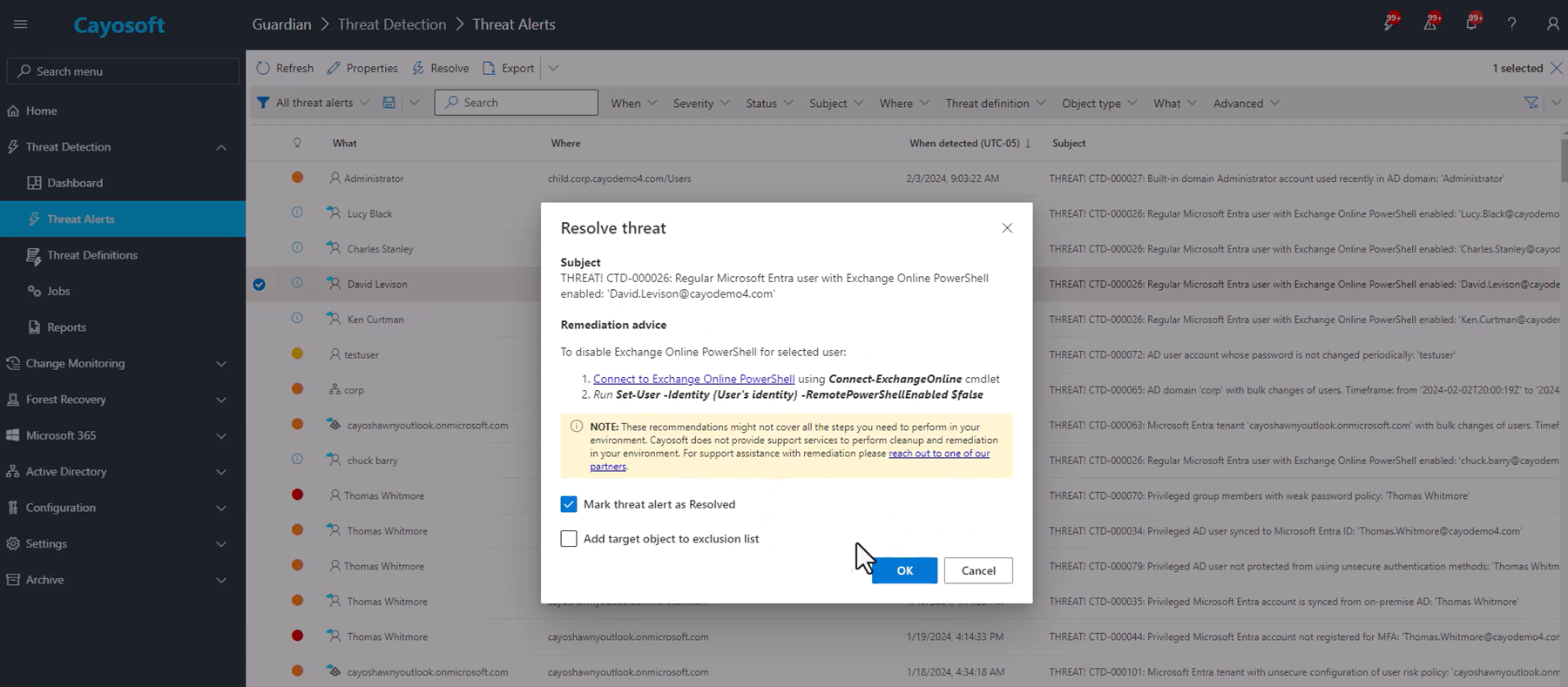
Cayosoft Guardian continuously monitors changes across Active Directory, Entra ID, Microsoft 365, Exchange, Teams, and Intune, providing real-time visibility, alerts, rollback, and audit-ready tracking from a single unified platform.
Detect suspicious activity, identify Indicators of Exposure (IOEs) and Indicators of Compromise (IOCs), and reverse unwanted changes before they become operational or security failures.
Why Active Directory Change Monitoring Matters
Identity systems are among the most frequently targeted components of enterprise infrastructure.
Attackers commonly target:
- Privileged groups
- Administrative roles
- Group Policy Objects (GPOs)
- Conditional Access policies
- Service accounts
- Delegation structures
- Authentication controls
- Synchronization services
At the same time, operational mistakes remain a major source of outages and identity disruption.
Examples include:
- Incorrect PowerShell execution
- Unauthorized privilege escalation
- Group membership changes
- Policy misconfiguration
- Accidental object deletion
- Improper delegation changes
- Hybrid synchronization errors
Cayosoft Continuously Monitors Hybrid Identity Changes
Cayosoft Guardian provides real-time monitoring across:
- Active Directory
- Entra ID
- Exchange
- Microsoft 365
- Teams
- Intune
Track changes involving:
- User accounts
- Group memberships
- Privileged roles
- Security policies
- Conditional Access
- GPOs
- Administrative permissions
- Service principals
- Mailbox permissions
All changes are captured with detailed context, including:
- Who made the change
- What changed
- When it changed
- Where it originated
- Previous and current values
Cayosoft Continuously Monitors Hybrid Identity Changes
Get Real-time Monitoring
Cayosoft Guardian provides real-time monitoring across:
- Active Directory
- Entra ID
- Exchange
- Microsoft 365
- Teams
- Intune
Track changes involving:
- User accounts
- Group memberships
- Privileged roles
- Security policies
- Conditional Access
- GPOs
- Administrative permissions
- Service principals
- Mailbox permissions
All changes are captured with detailed context, including:
- Who made the change
- What changed
- When it changed
- Where it originated
- Previous and current values
Detect Indicators of Exposure and Compromise
Not every risky condition is an active attack. Many environments already contain identity weaknesses that increase exposure.
Cayosoft helps identify:
Indicators of Exposure (IOEs)
Examples include:
- Excessive privileged accounts
- Dormant administrative users
- Stale group memberships
- Weak delegation boundaries
- Risky configuration drift
- Over-permissioned accounts
Indicators of Compromise (IOCs)
Examples include:
- Unauthorized admin assignment
- Privilege escalation attempts
- Suspicious group changes
- Policy tampering
- Mass object modification
- Unexpected Conditional Access changes
Continuous visibility helps organizations identify both operational risk and active identity threats.
Roll Back Unwanted Changes Instantly
Traditional recovery methods are too disruptive for routine identity mistakes.
Cayosoft Guardian enables granular rollback of:
- User changes
- Group membership changes
- Attribute modifications
- Administrative role assignments
- Policy changes
- Deleted objects
Restore specific objects or attributes without restoring domain controllers, backups, or entire environments.
Cayosoft Guardian positioning specifically emphasizes object-level and attribute-level rollback across hybrid AD and Entra ID environments without requiring backup restoration or downtime.
Reduce Operational and Security Risk
Many identity incidents begin as small, unnoticed changes.
Examples include:
- A user added to Domain Admins
- A Conditional Access policy was modified improperly
- A delegated admin granted excessive rights
- A synchronization rule changed unexpectedly
- A stale service account reactivated
Continuous Active Directory change monitoring shortens detection and response time while improving operational awareness across a hybrid identity infrastructure.
Eliminate Blind Spots Across Hybrid Microsoft Identity
Native Microsoft logging is often fragmented across multiple systems and consoles.
Organizations frequently depend on:
- Event Viewer
- PowerShell
- Entra audit logs
- SIEM queries
- Exchange logs
- Manual exports
- Multiple admin portals
This creates inconsistent visibility and delayed investigation workflows.
Cayosoft Guardian centralizes hybrid identity monitoring on a single operational platform.
Support Audit and Compliance Requirements
Compliance frameworks increasingly require visibility into identity changes and administrative activity.
Cayosoft helps organizations maintain audit-ready visibility for:
- SOX
- HIPAA
- GDPR
- PCI-DSS
- CJIS
- NIST 800-53
- ISO 27001
Capabilities include:
- Immutable change history
- Real-time alerting
- Administrative tracking
- Role assignment visibility
- Delegation auditing
- Exportable reporting
Built for Hybrid Identity Operations
Cayosoft Guardian was designed specifically for modern hybrid Microsoft identity environments.
Monitor and protect:
- Active Directory
- Entra ID
- Exchange
- Microsoft 365
- Teams
- Intune
from a single operational console.
The platform supports:
- Multi-domain environments
- Multi-forest environments
- Hybrid Exchange
- Large enterprise deployments
- Delegated administration models
- Agentless architecture
Real-Time Monitoring Without Heavy Operational Overhead
Many traditional monitoring solutions depend heavily on:
- SIEM tuning
- Agent deployment
- Complex scripting
- Native log parsing
- Manual alert correlation
Cayosoft Guardian provides purpose-built Active Directory change monitoring designed specifically for Microsoft hybrid identity systems.
The platform was built to provide operational visibility without requiring domain controller agents or fragmented monitoring workflows.
What Cayosoft Delivers
Continuous Hybrid Identity Visibility
Monitor changes across AD, Entra ID, Microsoft 365, Exchange, Teams, and Intune in real time.
Faster Threat Detection
Identify risky changes, privilege escalations, IOEs, and IOCs before they escalate into larger incidents.
Granular Rollback and Recovery
Reverse unwanted changes without restoring backups or disrupting production environments.
Centralized Audit Visibility
Track who changed what, when, and where from a single operational platform.
Reduced Operational Blind Spots
Eliminate fragmented monitoring across multiple Microsoft administrative systems.
Hybrid Identity Resilience
Support identity governance, operational continuity, compliance, and security initiatives together.
h2
text
Control Your Entire Microsoft Identity Environment
Active Directory|Entra ID|Microsoft 365|Intune
Detect threats, reverse unwanted changes, and recover Active Directory in minutes.
Cayosoft Enterprise Suite


FAQ
Active Directory (AD) change monitoring is the continuous observation, recording, analysis, alerting, and remediation of identity-related modifications across Microsoft identity systems.
This includes monitoring changes to:
- Users
- Groups
- Privileged roles
- Organizational Units (OUs)
- Group Policy Objects (GPOs)
- Administrative permissions
- Service accounts
- DNS-integrated AD components
- Entra ID roles
- Conditional Access policies
- Microsoft 365 identity settings
Modern change monitoring extends across a hybrid Microsoft identity infrastructure, not just on-premises AD.
Active Directory is a primary attack surface.
Most enterprise authentication and authorization depend on identity integrity.
Changes to identity systems can:
- Escalate privileges
- Expand lateral movement
- Disable security controls
- Break authentication
- Cause outages
- Create persistence mechanisms
- Circumvent compliance controls
Many security incidents originate from seemingly small identity changes that go unnoticed.
Critical identity changes typically include:
Privileged group membership changes
Examples:
- Domain Admins
- Enterprise Admins
- Schema Admins
- Backup Operators
- Entra Global Administrators
User account changes
Examples:
- Password resets
- Account enable/disable
- MFA modifications
- Attribute changes
- Delegation changes
Group Policy modifications
Examples:
- Security policy changes
- Login script changes
- Privilege assignment changes
- Defender policy changes
Administrative role assignment
Examples:
- Exchange admin assignment
- Entra role elevation
- Intune admin assignment
Hybrid synchronization changes
Examples:
- Azure AD Connect configuration changes
- Synchronization rule modifications
- Federation configuration changes
Conditional Access modifications
Examples:
- MFA bypass rules
- Policy exclusions
- Device trust changes
Native logs create operational challenges because they are:
- Fragmented
- Verbose
- Difficult to correlate
- Limited in retention
- Difficult to search at scale
- Not hybrid-aware
- Dependent on local infrastructure integrity
Challenges include:
- Event ID complexity
- Replication timing
- Distributed logging
- Inconsistent attribution
- SIEM ingestion overhead
Native logging alone rarely provides operationally useful visibility into changes.
Hybrid monitoring tracks identity changes across:
- Active Directory
- Entra ID
- Microsoft 365
- Exchange
- Teams
- Intune
- Azure-integrated identity systems
Hybrid environments require cross-platform correlation because identity workflows span multiple control planes simultaneously.
Traditional AD monitoring focused primarily on:
- LDAP changes
- Kerberos activity
- GPO modification
- Domain controller events
Hybrid environments introduce:
- Cloud APIs
- Multiple audit systems
- Token-based identity
- Conditional Access
- Cloud administrative roles
- SaaS authorization layers
Changes may originate from:
- Azure portals
- Microsoft Graph
- Exchange Online
- PowerShell
- Synchronization engines
- Automation workflows
Correlation becomes significantly more difficult.
Indicators of Exposure (IOEs) identify risky identity conditions that increase the attack surface, even if a compromise has not yet occurred.
Examples include:
- Excessive Global Admins
- Dormant privileged accounts
- Weak delegation boundaries
- Stale service accounts
- Excessive nested groups
- Disabled MFA
- Broad Conditional Access exclusions
- Over-permissioned identities
IOEs indicate elevated operational and security risk.
Indicators of Compromise (IOCs) suggest malicious activity may already be occurring.
Examples include:
- Unauthorized admin assignment
- Unexpected privilege escalation
- Mass group modifications
- GPO tampering
- Conditional Access bypass changes
- Suspicious service account changes
- Unexpected synchronization activity
IOCs often appear before broader infrastructure compromise becomes visible.
Attackers frequently target identity systems to obtain elevated privilege.
Common escalation techniques include:
- Adding users to privileged groups
- Delegation abuse
- Kerberos abuse
- AdminSDHolder modification
- SIDHistory abuse
- Azure role assignment
- Token manipulation
- Conditional Access weakening
Early detection of privilege escalation dramatically reduces attacker dwell time.
AdminSDHolder is a protected AD object controlling permissions inheritance for privileged accounts.
Attackers commonly target AdminSDHolder to:
- Establish persistence
- Backdoor privileged permissions
- Override delegation controls
Changes to:
- ACLs
- Inheritance
- Protected groups
should be considered highly sensitive.
Change attribution identifies:
- Who made a change
- What changed
- When it occurred
- Where it originated
- Which system initiated it
Accurate attribution is essential for:
- Incident response
- Compliance
- Forensics
- Administrative accountability
Identity attacks move quickly.
Examples:
Attack Stage | Possible Time Window |
Privilege escalation | Minutes |
Lateral movement | Minutes to hours |
Policy tampering | Immediate |
Ransomware deployment | Rapid |
Delayed detection significantly increases recovery complexity and operational damage.
PowerShell is heavily used for:
- Administration
- Automation
- Bulk changes
- Hybrid synchronization
- Exchange management
Attackers also heavily abuse PowerShell because it provides:
- Administrative reach
- Native trust
- Remote execution capability
- Access to Microsoft APIs
Monitoring PowerShell-originated changes is operationally critical.
GPOs affect:
- Authentication
- Endpoint security
- Defender configuration
- Privilege assignment
- Login behavior
- Administrative policy
GPO modification can rapidly impact entire enterprise environments.
Monitoring should include:
- GPO creation
- GPO deletion
- Link changes
- Security filtering changes
- Administrative template changes
Conditional Access policies control cloud authentication decisions.
Changes may:
- Disable MFA
- Bypass device trust
- Exclude administrative users
- Weaken access restrictions
Conditional Access tampering can immediately reduce identity security posture.
Detection alone is insufficient.
Organizations also need rapid remediation.
Rollback enables:
- Reversing privilege escalation
- Restoring deleted objects
- Undoing policy tampering
- Reverting configuration drift
- Correcting administrative mistakes
Granular rollback reduces operational disruption compared to backup restoration.
Cayosoft Guardian positioning specifically emphasizes object-level and attribute-level rollback across AD and Entra ID without requiring traditional restore operations.
Traditional backups are coarse-grained.
Restoring entire backups to recover one object can:
- Overwrite unrelated changes
- Create replication conflicts
- Introduce downtime
- Restore stale configurations
- Delay remediation
Modern identity operations increasingly require object-level remediation instead.
Not all incidents originate from attackers.
Common operational causes include:
- Misconfigured scripts
- Incorrect bulk updates
- Synchronization failures
- Human error
- Improper delegation
- Accidental deletion
- Group sprawl
- Policy drift
Paradigm Technica specifically modeled large-scale identity deletion caused by scripting errors as a realistic operational failure scenario.
SIEM platforms provide aggregation but often lack identity-specific operational context.
Challenges include:
- Excessive log volume
- Correlation complexity
- High tuning overhead
- Weak rollback integration
- Poor object-level visibility
- Hybrid identity blind spots
Identity monitoring frequently requires purpose-built context beyond generic event ingestion.
Immutable logs cannot be altered retroactively.
Benefits include:
- Forensic integrity
- Compliance evidence
- Non-repudiation
- Insider threat protection
This is especially important during ransomware or privilege abuse investigations.
Identity monitoring supports requirements within:
- SOX
- HIPAA
- GDPR
- PCI-DSS
- NIST 800-53
- CJIS
- ISO 27001
- FedRAMP
Auditors commonly evaluate:
- Privileged access changes
- Administrative activity
- Change attribution
- Audit retention
- Access review workflows
Service accounts often have:
- Elevated privilege
- Weak password rotation
- Broad delegation
- Long-lived credentials
Attackers frequently target service accounts because they are operationally sensitive and often poorly governed.
Monitoring should include:
- Password changes
- Delegation changes
- Privilege escalation
- SPN modifications
- Authentication anomalies
Configuration drift occurs when identity settings gradually diverge from the intended security policy.
Examples include:
- Group membership expansion
- Delegation changes
- MFA inconsistency
- Policy exclusions
- Legacy permission inheritance
Continuous monitoring helps detect drift before it becomes operationally dangerous.
Hybrid visibility
- AD support
- Entra ID support
- Microsoft 365 support
- Exchange support
- Teams support
- Intune support
Monitoring fidelity
- Object-level monitoring
- Attribute-level monitoring
- Real-time alerting
- Administrative attribution
Security capability
- IOC detection
- IOE detection
- Privilege escalation visibility
- Rollback support
Operational scalability
- Multi-domain support
- Multi-forest support
- Large enterprise scalability
- Agentless deployment
Compliance support
- Immutable logging
- Exportable reporting
- Audit retention
- SIEM integration
Large enterprises frequently accumulate fragmented tooling:
- SIEM platforms
- Native logs
- PowerShell auditing
- Exchange logging
- Cloud audit systems
- GPO monitoring products
This creates:
- Operational silos
- Inconsistent visibility
- Correlation gaps
- Administrative complexity
Unified identity monitoring platforms reduce operational fragmentation.
Identity resilience means organizations can:
- Detect unauthorized changes quickly
- Identify risky identity exposure
- Reverse harmful modifications
- Maintain operational continuity
- Preserve audit integrity
- Recover from compromise rapidly
Modern identity resilience increasingly combines:
- Monitoring
- Threat detection
- Rollback
- Governance
- Compliance
- Disaster recovery
Identity monitoring is no longer just auditing. It is an operational security infrastructure.
Modernize Active Directory Change Monitoring
Identity environments move too quickly for reactive monitoring and manual investigation. Cayosoft Guardian continuously monitors hybrid Microsoft identity systems, detects risky changes in real time, and enables immediate remediation before operational disruption or compromise spreads.