



Home » Ransomware Recovery: 10 Best Practices for Microsoft Environments » How to Build a Ransomware Recovery Plan
How to Build a Ransomware Recovery Plan
Learn how modern ransomware works, why traditional defenses fail, and how to build a resilient recovery plan.
Explore the chapters:
Next Chapter >
Stop AD Threats As They Happen
Cayosoft Protector provides continuous monitoring and real-time alerts across your entire Microsoft Identity stack
Like This Article?
Subscribe to our LinkedIn Newsletter to receive more educational content
Ransomware has evolved into a highly sophisticated, massively profitable criminal industry. It is no longer just a collection of disruptive malware—it is a black‑market business built on data theft, intellectual‑property extraction, and direct extortion through encrypted systems.
The scale and precision of modern attacks have fundamentally changed how organizations must approach prevention, detection, and recovery. As attacks grow more advanced, organizations are struggling to keep pace with new regulations and to answer the core questions that determine their resilience:
- How do attackers get in?
- How do they remain undetected for months?
- How do we prevent, contain, and respond effectively?
- How do we build recovery plans that actually work when everything is on the line?
This article introduces the modern answers to those questions. It sets the foundation for a series of deeper, focused articles that will explore each area—prevention, detection, backup strategy, and recovery—in greater detail.
Summary of key ransomware recovery concepts
| Concept | Description |
|---|---|
| Foundational planning | This planning includes gaining extensive environmental knowledge; setting clear and documented business continuity expectations and regulations; developing collaborative plans that include all IT; establishing business requirements and roles in recovery exercises, and assessing gaps and methods of mitigation. Business continuity and time to recovery planning are part of this. |
| Prevention planning | These are security practices designed to prevent breaches, including efforts related to architecture, phishing deterrents/blocks, least privilege models, and automated detection and response. |
| Backup planning | Restoration is impossible without backup planning, which should include all IT and business-critical systems required to ensure business continuity. Backup planning must account for preventing reinfection and the possibility of ransomware that infiltrated weeks/months prior to discovery. |
| Recovery planning | This aspect outlines the steps that are to be taken during recovery after an attack, including isolation, assessment, restoration, remediation, heightened monitoring, and post-mortem evaluation. Each critical system requires a recovery plan that includes the steps and interactions of all other IT and business-critical parties and systems. |
A brief history of ransomware
Three key trends propelled ransomware from an annoyance to a global criminal enterprise: ones related to payment, method, and target, each shaped by motive and technology.
The first known ransomware attack in 1989 used mail‑in checks and simple file encryption delivered on floppy disks. Dr. Joseph Popp, angry about being excluded from an AIDS conference, mailed infected disks to attendees, then demanded payment in the form of a check to be sent to a Panama bank. The attack was crude, limited, and easily overcome, but it introduced the extortion model still used today.
From 1989 to 2012, attackers primarily targeted individuals. Screen‑locking malware disrupted businesses, but large‑scale ransoming was limited. Payment was difficult, infiltration was harder, and organizations had simpler, more contained environments. But by 2012, everything had changed. Companies were embracing BYOD, remote work, and cloud services. Encryption became stronger, and attackers realized the financial potential.
Then came the real inflection point: Bitcoin in 2013. Instant, anonymous payment transformed ransomware into big business. Criminal groups formed structured organizations. Cloud adoption, remote access, and hybrid environments expanded the attack surface. Motive shifted almost entirely to profit, and high‑value enterprises and essential‑service organizations—especially in healthcare—became prime targets.
Today’s dominant tactic is double‑extortion: steal data quietly, then encrypt everything. Attackers infiltrate and linger for months, exfiltrating sensitive data and planting the malware that will later take the environment hostage. By the time encryption hits, the damage is already done.
Ransomware as big business
Today’s ransomware isn’t written by hobbyists—it’s built and delivered by well‑run criminal organizations. Cloud adoption gave these groups global reach, and ransomware as a service (RaaS), which first appeared around 2012, turned ransomware into a scalable business model. Early examples like the “FBI Virus” from the Reveton group showed how easily ransomware could be packaged, sold, and deployed by anyone willing to pay.
By 2025, ransomware groups generated an estimated $820–900 million in revenue, while global economic damage exceeded $57 billion. That gap between attacker profit and organizational loss is exactly why the model thrives.
RaaS groups operate like real companies. Their ecosystem has three core roles:
- RaaS operators maintain infrastructure, develop the malware, and run the leak sites.
- Affiliates purchase or lease the ransomware, conduct the attacks, and share profits with operators.
- Initial access brokers (IABs) specialize in gaining entry through phishing, social engineering, or technical exploitation, then sell that access to affiliates.
Each role is specialized, profitable, and optimized for scale, which is why attackers innovate faster than defenders.
A handful of groups have shaped the modern landscape, as shown below.
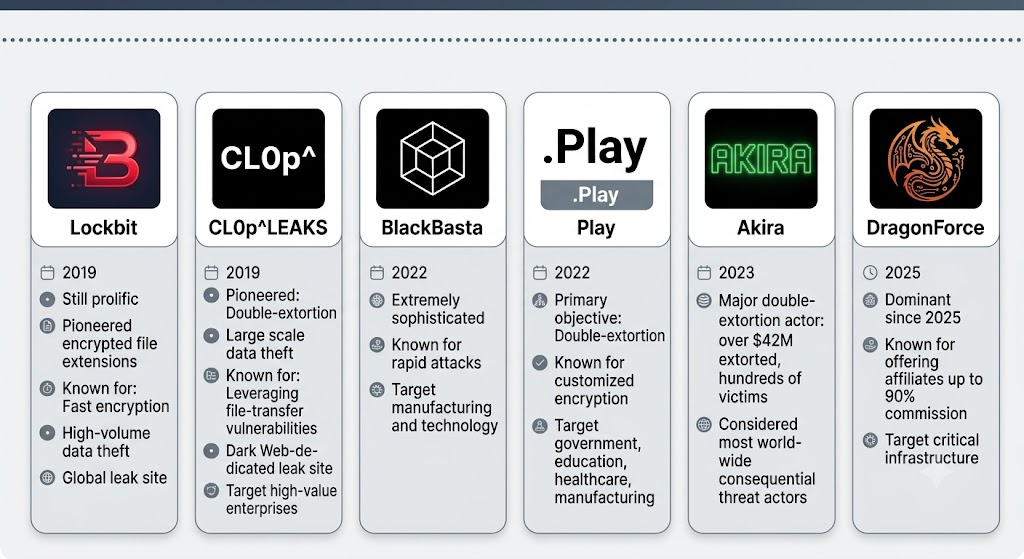
Common ransomware actors
These groups aren’t the only players, but they’ve driven the most significant advancements in tactics and technology. They’re behind hundreds, if not thousands, of high‑impact attacks.
Cayosoft Administrator
Cayosoft Administrator provides a unified console for managing hybrid AD, Entra ID, Microsoft 365, and Intune from a single pane of glass. Defining role-based access controls, delegating administrative authority, and enforcing least-privilege before an incident occurs is significantly easier when all identity management flows through one platform.
Regulatory pressure and ransomware response
As ransomware has grown more destructive, governments and regulatory bodies have shifted responsibility onto organizations. Agencies now extend existing laws and create new ones that address data leaks, disclosure requirements, and even ransom payments. The penalties are significant: financial, operational, and in some cases personal.
Most regulations fall into three primary categories: personal data protection, mandatory disclosure, and financial sanctions. These are explored in more detail below.
The long-term impact of these and other regulations is hard to assess. However, in the short term, these regulations have increased technology costs and forced organizations to adopt hastily built prevention, detection, response, and recovery plans. They’ve also pushed ransomware groups to evolve, driving double extortion, stronger encryption, and higher ransom demands. And despite stricter laws, attacker revenue continues to rise: The average ransom payment has grown from roughly $1 million in 2023 to more than $5 million today.
Personal data protection regulations
These laws require organizations to safeguard personal and sensitive information, limit how it’s used, and provide mechanisms for individuals to control their data. Violations can result in major fines, business disruption, and personal accountability for compliance failures.
The table below lists prominent regulations for personal data protection.
| Regulation | Description |
|---|---|
| HIPPA/HITECH | Federal regulation for the healthcare industry |
| GLBA/FCRA | Federal regulation for the financial industry |
| COPPA | Federal regulation for any industry that collects data from children |
| PCI DSS | International, self-regulated mandate for any industry that accepts credit cards as payment |
| GDPR | UK regulation for any industry that conducts business with European citizens |
| LGPD | Brazilian regulation for any industry that conducts business with Brazilian citizens |
Cayosoft Guardian Audit & Restore — Continuous Change Monitoring
Cayosoft Guardian Audit & Restore monitors every change across on-premises AD, Entra ID, and Microsoft 365 in real time. Changes to privileged group memberships, Conditional Access policies, and GPOs trigger immediate alerts — and can be rolled back with a single click, without requiring a full backup restore.
Mandatory disclosure regulations
Ransomware‑specific disclosure laws are more recent, beginning with CIRCIA in 2022. Although CIRCIA outlines mandatory reporting requirements for the 16 US critical infrastructure sectors, its enforcement and reporting deadlines are not yet active. It is also not the only regulation that requires mandatory disclosure; several industry‑specific frameworks, such as those in finance, already impose strict breach‑notification rules.
Once fully in effect, CIRCIA will require organizations to notify designated agencies and affected individuals within defined timelines, often including whether a ransom was paid. Many of these regulations also mandate baseline security controls such as backups, isolation capabilities, and industry‑specific protections.
Here are some of the prominent regulations for mandatory disclosure.
Regulation | Description |
CIRCIA | Spans critical infrastructure entities. Requires cyber incidents, including ransom payout, to be reported to CISA within 72 hours. |
HIPPA Security Rule | This rule, which was added in 2003, was updated in 2025/2026 to include specific required actions for ransomware incidents. If a breach is suspected but the investigation is inconclusive, the health organization must report the compromise anyway. |
FCT | Holds organizations liable for ineffective security measures. This Act is not new, but is now applied in ransomware scenarios |
FISMA | Mandates specific security controls for federal systems of information. Again, this is an older act now being applied to ransomware security controls. |
SEC Cybersecurity Rule | Effective in 2023, this rule spans all public companies and requires disclosure of incidents, including their nature, scope, timing, material impact, and ransom payout. It also requires annual reporting of risk management, strategy, and governance. |
GLBA | Requires data breach reporting to federal regulators. |
GDPR | Requires breach notification within 72 hours. |
NIS 2 Directive | Applies to critical sectors but enforces strict and demanding reporting requirements. |
Financial sanctions
To weaken ransomware groups, governments are increasingly restricting ransom payments. Several US states now prohibit public entities from paying ransoms, and broader sanctions impose heavy penalties for non‑compliance.
Important regulations that impose financial sanctions are described in the table below.
Regulation | Description |
OFAC Regulations | Federal US Treasury regulations that prohibit ransomware payout to entities on the Specially Designated Nationals list (SDN), including if duress was the reason for payout. |
Anti-money-laundering (AML) laws | Federal laws that already exist for the financial industry that require ransomware payouts to be reported to the FinCEN via suspicious activity reports. |
State-level bans | State legislation prohibiting state government entities from paying ransomware demands. |
Terrorism financing laws | International laws that have been in existence for decades that make paying ransoms to terrorist groups illegal. These laws are also being applied to ransomware incidents. |
Inadequacies of traditional prevention, response, and recovery
The frequency and financial impact of modern attacks have made it obvious that conventional approaches simply don’t hold up anymore. The old playbook was built for a different era—simpler networks, no cloud layers, limited remote access, and ransomware that was far less organized or destructive. Back then:
- Detection meant spotting obvious anomalies on the internal network.
- Prevention relied on stronger firewalls and network controls.
- Antivirus handled most endpoint threats.
- Backups were clean, predictable, and recoverable.
And for a long time, that was enough.
The shift happened when ransomware operators learned to linger. According to Mandiant’s M‑Trends 2026, the median dwell time now sits at 14 days—more than enough for attackers to establish persistence, move laterally, and compromise backups. Every backup taken during that window quietly captures the intrusion while significant volumes of data are exfiltrated for leverage. When encryption finally hits, organizations are left with the same two choices: Pay the ransom or attempt to roll back to a point before the breach. The latter option is often unworkable and has pushed many companies to the brink.
Prevention and detection gaps remain a major weakness. Even with role‑based controls, most organizations still have unknown or unintended elevated privileges across hybrid environments. Attackers exploit these blind spots using privileges that don’t look like traditional suspicious activities and generate events that most monitoring tools never see.
Identity remains the primary target. Active Directory still underpins authentication for most enterprises, and compromised domain controllers appear in the majority of intrusions. While AD supports traditional recovery methods—like system state backups, authoritative restores, and IFM builds—those approaches assume a clean, uncompromised restore point. In ransomware cases where attackers have maintained persistence, that assumption rarely holds. Their tooling, credential theft artifacts, and directory‑level changes replicate across all DCs, into every backup set, and malware is present in the system state backups. As a result, the only trustworthy rollback point is often before the initial compromise, creating weeks or months of directory drift that most organizations cannot absorb and where recovery plans collapse.
The uncomfortable truth is that ransomware groups know exactly where these weaknesses are. They’re organized, strategic, and intentional, giving them a massive advantage even as organizations work to modernize defenses.
Cayosoft Guardian — Change History That Survives an Attack
Threat actors frequently target native event logs to reduce forensic visibility before encryption begins. Cayosoft Guardian Audit & Restore maintains a continuous, immutable change history that records identity changes even when security logs or SIEM tools are compromised, providing the forensic timeline needed for root-cause analysis after the incident.
New methods and best practices to consider
Modern ransomware demands a complete shift in how organizations approach prevention, security operations, continuity, and recovery. Today’s methods must shift left of the attack, prioritizing prevention, real‑time detection, and recovery technologies built for long dwell times and strict regulatory requirements. The goal is to prevent incidents, detect early, maintain viable backups, and recover cleanly even when corruption began months earlier.
Every organization should evaluate four core areas:
- Foundational planning to expose gaps
- Prevention planning to stop attacks early
- Backup planning to ensure clean, viable recovery points
- Recovery planning to restore operations quickly and safely
Foundational planning
Foundational planning is the most critical step—and often the most overlooked. Without it, organizations miss dependencies, hidden risks, and the gaps attackers exploit.
Key components of foundational planning include the following:
- Environment discovery and documentation: It’s necessary to create a complete and documented inventory of the environment, including production, dev/test, cloud, endpoints, identities, certificates, vendors, partners, and network segments. The goal is to identify all components of the environment for business and technology, and capture dependencies as well as begin to form a priority based on critical systems and processes. This requires cross‑organizational involvement and often external tools or partners to scope accurately.
- Documented requirements and compliance: Teams cannot build effective continuity or recovery plans without understanding the regulations governing their industry. Documenting these requirements ensures that decisions align with legal, operational, and financial obligations. Each discovered process and system should be evaluated for compliance.
- Cross-organizational playbooks: Playbooks define who does what, in what order, and with what dependencies. They form the basis for business continuity plans (BCPs) and meeting time‑to‑recovery (TTR) requirements, both of which are impossible to meet without clear, documented workflows.
- Gap identification and mitigation strategy: Discovery naturally exposes security, architectural, and recovery gaps. These must be prioritized and addressed through process changes, cleanup efforts, modernization, or new technologies.
Prevention planning
The most effective ransomware strategy is prevention. Here are the specific areas related to prevention planning:
- Architectural hardening: Critical systems such as AD domain controllers, DNS and DHCP servers, network segments, and cloud connectors must be secured. Dev/test environments, often neglected, are common entry points and must be included.
- Least privilege models: True least privilege is nearly impossible with native tools, especially in legacy AD environments. Modern identity‑security platforms such as Cayosoft Administrator, CyberArk, and BeyondTrust are essential to eliminate privilege sprawl and enforce proper access controls.
- Phishing prevention and detection: Because phishing remains the primary entry vector, organizations must invest in user training and modern detection platforms like Abnormal AI or Adaptive Security. If attackers gain access, tools like Cayosoft Guardian can detect identity‑based changes and provide threat auditing and gap analysis.
- Automated detection and response: Once attackers infiltrate, changes happen fast, including privilege escalation, lateral movement, data exfiltration. Automated response is the only way to stop these actions before they spread or contaminate backups. Platforms such as Cayosoft Guardian provide automated threat detection, rollback, and rapid AD/Entra recovery. Cayosoft Guardian Protector is a free version that provides threat scans and analysis and real-time audit.
Cayosoft Guardian Instant Forest Recovery
Cayosoft Guardian Instant Forest Recovery is the only solution on the market providing instant AD forest recovery, completing in minutes rather than the hours or days required by traditional backup-based methods. It automates the sequencing of FSMO role transfers, krbtgt resets, and DC restoration, eliminating the manual sequencing errors that routinely extend post-ransomware outages.
Backup planning
Even with strong prevention, incidents can happen, and recovery is impossible without clean, viable backups. Modern ransomware makes this situation harder than ever, which is why backup planning must be deliberate, comprehensive, and aligned with how attackers operate today.
Because ransomware often infiltrates months before detection, backups must be evaluated for contamination. Backup methods, storage isolation, and OS‑level infection risks must be considered to avoid restoring malware back into production.
Cloud‑enabled backup platforms are becoming the modern standard because they provide separation from on‑premises compromise, stronger immutability controls, and more resilient recovery options.
Backup planning must include every system required for business continuity, including Active Directory, which cannot be restored using traditional system‑state methods. AD is fundamental to authentication and access; if it’s not recoverable, nothing else is.
Infrastructure, file, and database backup considerations
Modern ransomware changes the rules for infrastructure, file, and database backups. Because attackers linger for weeks or months before detection, clones and traditional image‑based backups are no longer reliable, since they often capture the infection right along with the system.
Organizations should evaluate modern backup solutions that:
- Avoid OS‑level cloning, which preserves embedded malware
- Provide immutable, isolated storage
- Offer anomaly detection to identify corrupted restore points
- Support rapid, clean recovery without reintroducing the threat
- Leverage cloud‑based architectures for isolation, durability, and scale
Cayosoft Guardian — One-Click Object Rollback
For environments where the Recycle Bin was not enabled—or where granular rollback of attributes, group memberships, GPOs, or Microsoft 365 configurations is needed—Cayosoft Guardian Audit & Restore provides one-click rollback for any change tracked in its continuous change history. Individual attributes, entire objects, or bulk group membership changes can be reversed in seconds, without depending on file-based backup restores.
AD‑specific backup requirements
Vendors must be able to:
- Create backups without system state
- Encrypt and protect backup files
- Validate AD backup health
- Meet Microsoft’s AD backup requirements
Cayosoft Guardian is currently the only platform that meets all of these criteria.
Recovery planning
With strong foundational planning, recovery becomes structured and predictable. Recovery plans should define the steps required to restore systems, the order of operations, responsible teams, access methods, and break‑glass procedures.
Most experts categorize recovery tasks into six sequential phases:
- Isolation: Defining how to isolate systems, networks, and workloads to prevent spread and enable safe recovery before, during, and after an attack.
- Assessment: Evaluating impact and determining which parts of the recovery plan must be executed. Without prior planning, this phase becomes slow, chaotic, and error‑prone.
- Restoration and recovery: Executing the predefined recovery steps, restoring systems in the correct order, and ensuring that dependencies are met.
- Remediation: Validating that recovered systems are clean. Automated validation—such as Cayosoft Guardian’s daily clean AD recovery—dramatically reduces recovery time.
- Heightened monitoring: Temporarily increasing monitoring, logging, scanning, and reporting to ensure that no lingering threats remain.
- Post mortem evaluation: A deep forensic review of how the breach occurred, its full impact, and what must be permanently remediated. For many industries, this is a regulatory requirement.
Cayosoft — Unified Hybrid AD and Microsoft 365 Visibility
Cayosoft’s platform covers on-premises AD, Entra ID, and Microsoft 365—including Teams, Exchange, and Intune—from a single console. Changes across all integrated Microsoft services are recorded in a unified change history, making it straightforward to identify which cloud configurations were modified during an incident and roll them back without switching between native admin portals.
Last thoughts
For organizations to beat ransomware, they need to rethink and rebuild their prevention, detection, backup, and recovery strategies. The last decade has made unmistakably clear that what used to be good simply isn’t good enough anymore.
The scope of the work can feel overwhelming, but this overview is only the beginning. The chapters that follow will break each area down in depth so you can build a modern, defensible strategy. For now, use this foundation to evaluate your current tools, technologies, and methods. Is your organization truly prepared?
New platforms emerge every day—solutions like Cayosoft and others purpose‑built to confront the scale and sophistication of today’s ransomware threat. The organizations that act now, with clarity and intention, will be the ones positioned to withstand what comes next.
Stop AD Threats As They Happen
Cayosoft Protector provides continuous monitoring and real-time alerts across your entire Microsoft Identity stack
Like This Article?
Subscribe to our LinkedIn Newsletter to receive more educational content