



Use CasesMonitor
Detect Active Directory and Entra ID Threats Before They Become Outages
Real-Time Hybrid Identity Threat Detection Across AD, Entra ID, and Microsoft 365
“RBAC enforcement is intuitive and effective. Cayosoft helped us enforce the least privilege across environments.”
— quoter
Microsoft Hybrid Identity Systems Are The First Line of Attack
Identity systems are a primary target for attackers. Privilege escalation, unauthorized group changes, policy tampering, dormant admin abuse, and hybrid identity misconfigurations can quickly spread across Active Directory and Microsoft cloud environments.
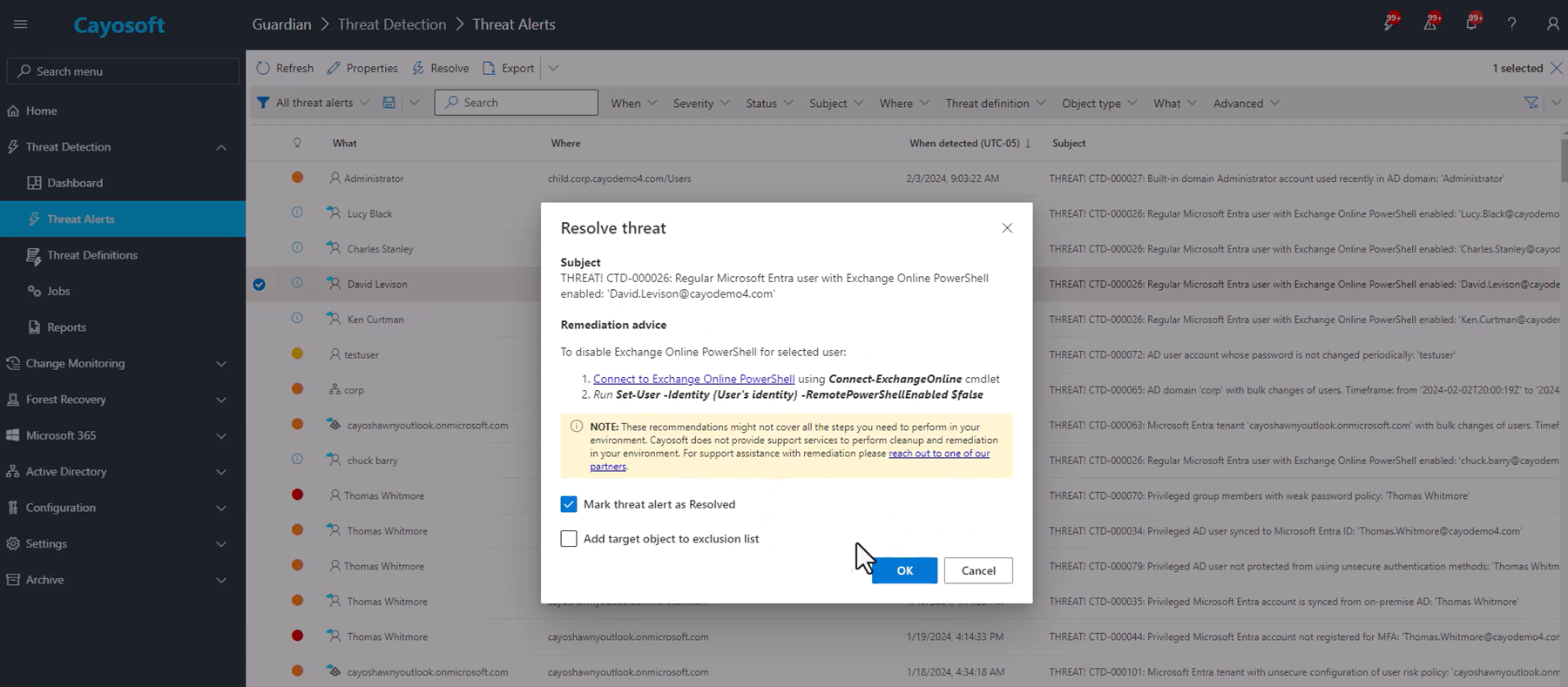
Cayosoft Guardian continuously detects risky identity activity across Active Directory, Entra ID, Microsoft 365, Exchange, Teams, and Intune, providing real-time identity threat detection, alerts, rollback, and audit-ready tracking from a single operational platform.
Identify Indicators of Exposure (IOEs), Indicators of Compromise (IOCs), and suspicious identity changes before they escalate into operational disruption, privilege abuse, or ransomware impact.
Why Identity Threat Detection Matters
Modern attacks increasingly target identity infrastructure first.
Attackers commonly attempt to:
- Escalate privileges
- Modify administrative groups
- Abuse service accounts
- Tamper with Group Policy
- Weaken Conditional Access
- Expand lateral movement
- Persist inside identity systems
- Disable security controls
At the same time, operational mistakes often create the same exposure conditions that attackers rely on.
Examples include:
- Excessive admin assignment
- Weak delegation boundaries
- Misconfigured synchronization
- Over-permissioned service accounts
- Unrestricted group membership changes
- Poor lifecycle governance
Without continuous visibility into identity activity, organizations often discover compromise only after attackers gain persistence or business operations are disrupted.
h3
text
- listitem
- listitem
- listitem
h2
text
Cayosoft Continuously Monitors Hybrid Identity
Continuous Hybrid Identity Threat Detection
Cayosoft Guardian continuously monitors identity activity across:
- Active Directory
- Entra ID
- Exchange
- Microsoft 365
- Teams
- Intune
Detect suspicious activity involving:
- Privileged groups
- Administrative roles
- Service accounts
- GPO modifications
- Conditional Access changes
- Delegation changes
- User lifecycle events
- Group membership escalation
- Authentication policy changes
All activity is captured with detailed operational context, including:
- Who performed the action
- What changed
- When it occurred
- Where the activity originated
- Previous and current values
Identify Indicators of Exposure Before Attackers Do
Many environments already contain identity weaknesses that increase attack surface long before compromise occurs.
Cayosoft helps identify Indicators of Exposure (IOEs), including:
- Excessive privileged accounts
- Dormant administrative identities
- Stale group memberships
- Weak delegation structures
- Misconfigured security policies
- Excessive role assignment
- Over-permissioned service accounts
- Identity configuration drift
Reducing exposure lowers the likelihood of privilege abuse and lateral movement.
Detect Indicators of Compromise in Real Time
Identity attacks frequently begin with subtle administrative changes.
Cayosoft detects Indicators of Compromise (IOCs), including:
- Unauthorized admin assignment
- Privilege escalation attempts
- Mass object modification
- Suspicious group membership changes
- Conditional Access tampering
- GPO modification
- Administrative abuse
- Unexpected synchronization activity
Real-time visibility shortens detection and response time before compromise spreads further into the environment.
Roll Back Risky Identity Changes Instantly
Identity threat detection alone is not enough. Security teams also need rapid remediation.
Cayosoft Guardian enables immediate rollback of:
- User changes
- Group modifications
- Privileged role assignments
- Attribute changes
- Policy changes
- Deleted objects
Restore specific objects or attributes without restoring domain controllers, backups, or entire environments.
Cayosoft Guardian positioning specifically emphasizes object-level and attribute-level rollback across AD and Entra ID environments without requiring traditional backup restoration or downtime.
Reduce Identity Attack Surface
Many identity risks develop gradually over time.
Examples include:
- Privilege accumulation
- Stale administrative access
- Nested group sprawl
- Weak service account governance
- Inconsistent MFA coverage
- Broad Conditional Access exclusions
Continuous identity monitoring helps organizations reduce operational and security exposure before attackers exploit these conditions.
Eliminate Blind Spots Across Hybrid Microsoft Identity
Native Microsoft visibility is fragmented across multiple systems and administrative portals.
Organizations frequently rely on:
- Event Viewer
- PowerShell
- Entra audit logs
- SIEM dashboards
- Exchange logging
- Multiple admin consoles
- Manual exports
This creates delayed investigation workflows and inconsistent operational visibility.
Cayosoft Guardian centralizes identity threat detection into one unified operational platform.
Support Zero Trust Identity Security
Zero Trust requires continuous validation of:
- Identity
- Privilege
- Access scope
- Administrative activity
- Policy enforcement
Cayosoft supports Zero Trust initiatives by helping organizations:
- Reduce standing privilege
- Detect unauthorized changes
- Monitor administrative activity
- Enforce least privilege
- Identify risky exposure conditions
- Improve visibility into hybrid identity systems
Support Compliance and Audit Requirements
Identity monitoring and threat visibility are increasingly required for compliance frameworks, including:
- SOX
- HIPAA
- GDPR
- PCI-DSS
- CJIS
- NIST 800-53
- ISO 27001
Cayosoft helps organizations maintain:
- Immutable change visibility
- Administrative audit trails
- Real-time alerting
- Exportable reporting
- Identity governance visibility
- Privileged activity tracking
Built for Hybrid Microsoft Identity Operations
Cayosoft Guardian was purpose-built for hybrid Microsoft identity environments.
Monitor and protect:
- Active Directory
- Entra ID
- Exchange
- Microsoft 365
- Teams
- Intune
from a single operational console.
The platform supports:
- Multi-domain environments
- Multi-forest environments
- Hybrid Exchange
- Large enterprise deployments
- Delegated administration models
- Agentless architecture
Identity Threat Detection Without Heavy Operational Overhead
Many traditional monitoring solutions require:
- Extensive SIEM tuning
- Agent deployment
- Custom scripting
- Native log parsing
- Complex alert correlation
Cayosoft Guardian provides identity-focused monitoring designed specifically for hybrid Microsoft identity systems without requiring fragmented operational workflows.
What Cayosoft Delivers
Continuous Hybrid Identity Threat Detection
Monitor AD, Entra ID, Microsoft 365, Exchange, Teams, and Intune in real time.
Faster Detection of Identity-Based Threats
Identify privilege escalation, suspicious changes, IOEs, and IOCs before compromise spreads.
Immediate Rollback and Remediation
Reverse unwanted identity changes without restoring backups or disrupting production systems.
Centralized Operational Visibility
Track identity activity, policy changes, and administrative actions from one platform.
Reduced Identity Exposure
Continuously identify risky configurations and excessive privilege conditions.
Hybrid Identity Resilience
Support identity governance, operational continuity, security, and compliance together.
h2
text
Control Your Entire Microsoft Identity Environment
Active Directory|Entra ID|Microsoft 365|Intune
Detect threats, reverse unwanted changes, and recover Active Directory in minutes.
Cayosoft Enterprise Suite


FAQ
Active Directory (AD) threat detection is the continuous monitoring, analysis, correlation, and remediation of suspicious identity-related activity across the Microsoft identity infrastructure.
Modern AD threat detection includes monitoring:
- Active Directory
- Entra ID
- Microsoft 365
- Exchange
- Teams
- Intune
- Hybrid synchronization systems
- Administrative roles
- Authentication systems
- Identity governance controls
The objective is to detect:
- Privilege escalation
- Identity abuse
- Persistence mechanisms
- Administrative compromise
- Lateral movement
- Policy tampering
- Configuration drift
- Suspicious lifecycle activity
before attackers can expand control across the environment.
Active Directory is the authentication and authorization backbone of most enterprise Microsoft environments.
Control of AD frequently means control of:
- Authentication
- Authorization
- Administrative privilege
- Group Policy
- Endpoint trust
- Application access
- Federation
- Hybrid identity synchronization
Attackers target AD because compromising identity infrastructure allows broad operational control without immediately attacking endpoints or servers directly.
Modern identity environments span:
- On-prem AD
- Entra ID
- Microsoft 365
- SaaS integrations
- Exchange Online
- Teams
- Intune
- Azure RBAC
- Conditional Access
Attackers increasingly target identity because:
- Cloud trust depends on identity
- Administrative privilege spans environments
- Federation creates trust chains
- Hybrid synchronization expands the attack surface
Identity compromise frequently precedes ransomware deployment, data theft, or operational disruption.
Privilege escalation
Attackers attempt to gain elevated rights through:
- Group membership changes
- ACL abuse
- Delegation abuse
- Kerberos attacks
- SIDHistory abuse
Credential abuse
Examples include:
- Pass-the-Hash
- Pass-the-Ticket
- Kerberoasting
- NTLM relay
- Golden Ticket attacks
Persistence mechanisms
Examples include:
- AdminSDHolder modification
- GPO persistence
- Shadow admins
- Rogue service accounts
- Backdoor delegation
Lateral movement
Examples include:
- Remote PowerShell
- SMB abuse
- WMI
- RDP
- Token impersonation
Hybrid identity abuse
Examples include:
- Conditional Access tampering
- Entra role assignment
- Azure AD Connect compromise
- OAuth abuse
- Service principal abuse
Hybrid identity threat detection monitors identity-related threats across both on-premises and cloud Microsoft infrastructure.
This includes visibility into:
- Active Directory
- Entra ID
- Microsoft 365
- Exchange
- Teams
- Intune
- Azure-integrated services
Hybrid identity threat detection is necessary because modern attacks frequently move between on-prem and cloud identity systems.
Native logs create operational challenges because they are:
- Fragmented
- Distributed
- Difficult to correlate
- Extremely verbose
- Often short-lived
- Platform-specific
Organizations frequently depend on:
- Event Viewer
- Entra audit logs
- Azure logs
- Exchange logs
- SIEM ingestion
- PowerShell tracing
Correlation across systems becomes operationally difficult at enterprise scale.
Indicators of Exposure (IOEs) are risky identity conditions that increase the attack surface even if a compromise has not yet occurred.
Examples include:
- Excessive privileged accounts
- Dormant admin accounts
- Weak delegation boundaries
- Stale service accounts
- Excessive nested groups
- Unused privileged groups
- Broad Conditional Access exclusions
- Disabled MFA coverage
- Inconsistent lifecycle governance
IOEs represent elevated operational risk.
Most attacks succeed because risky conditions already exist.
Examples:
Exposure Condition | Possible Outcome |
Dormant admin account | Credential abuse |
Weak delegation | Privilege escalation |
Over-permissioned groups | Lateral movement |
Excessive Global Admins | Tenant-wide compromise |
Reducing IOEs reduces attacker opportunity.
Indicators of Compromise (IOCs) suggest malicious activity may already be occurring.
Examples include:
- Unauthorized admin assignment
- Mass group modification
- Unexpected GPO changes
- Suspicious Conditional Access edits
- Rogue synchronization activity
- Service principal abuse
- Privileged account creation
- Off-hours administrative activity
IOCs often appear before operational disruption becomes obvious.
Attackers rarely begin with full administrative control.
Privilege escalation is often the first major objective in an attack.
Common escalation targets include:
- Domain Admins
- Enterprise Admins
- Global Administrators
- Exchange Administrators
- Azure RBAC roles
- Backup Operators
Monitoring privilege changes is essential because elevated access enables persistence and lateral movement.
Shadow admins are accounts with effective administrative influence without formal membership in a privileged group.
Examples include:
- Delegated ACL control
- GPO modification rights
- OU-level delegation
- Service account privilege
- Exchange administrative delegation
Shadow admins often bypass traditional privileged group monitoring.
AdminSDHolder is a protected object controlling ACL inheritance for privileged accounts.
Attackers may modify AdminSDHolder to:
- Backdoor permissions
- Maintain persistence
- Reapply malicious ACLs automatically
Changes to AdminSDHolder should be considered high-risk events.
SIDHistory allows legacy migration compatibility by preserving historical SIDs.
Attackers may inject privileged SIDs into SIDHistory to obtain unauthorized access.
SIDHistory abuse is difficult to detect without deep visibility into identities.
Service accounts frequently have:
- Elevated privilege
- Weak password rotation
- Broad delegation
- Long-lived credentials
- Limited MFA support
Attackers commonly target service accounts because they are operationally sensitive and often poorly governed.
Monitoring should include:
- Password changes
- SPN changes
- Delegation modifications
- Group membership changes
- Authentication anomalies
Kerberoasting is an attack technique in which attackers request Kerberos service tickets for service accounts and then attempt offline password cracking.
High-risk conditions include:
- Weak service account passwords
- Excessive SPNs
- Privileged service accounts
Threat detection should monitor:
- Unusual TGS requests
- Service ticket anomalies
- SPN enumeration behavior
Golden Ticket attacks involve forging Kerberos Ticket Granting Tickets (TGTs) after the compromise of the KRBTGT account.
This allows attackers to impersonate identities with effectively unlimited privilege.
Golden Ticket activity is extremely dangerous because it undermines trust across the domain.
Conditional Access controls cloud authentication decisions.
Attackers may attempt to:
- Disable MFA
- Exclude privileged users
- Weaken device trust requirements
- Modify session policies
Conditional Access tampering can rapidly reduce security posture across Microsoft 365.
Azure AD Connect bridges on-prem AD and Entra ID.
Compromise of synchronization systems may allow attackers to:
- Propagate malicious changes
- Escalate privilege into cloud systems
- Manipulate identity synchronization
- Establish hybrid persistence
Synchronization infrastructure should be treated as Tier-0 identity infrastructure.
GPOs control:
- Endpoint security
- Authentication behavior
- Administrative policy
- Defender configuration
- Software deployment
GPO abuse can rapidly impact thousands of systems simultaneously.
Threat detection should monitor:
- GPO creation
- GPO deletion
- Link changes
- ACL changes
- Policy content modification
PowerShell is widely used for:
- Administration
- Automation
- Microsoft Graph access
- Hybrid synchronization
- Exchange management
Attackers also heavily abuse PowerShell because it provides:
- Native administrative access
- Remote execution
- API integration
- Credential access
Monitoring PowerShell-originated changes is operationally critical.
SIEM platforms aggregate events but often lack identity-specific operational context.
Challenges include:
- Massive log volume
- Excessive tuning requirements
- Weak object-level visibility
- Correlation complexity
- Limited rollback integration
- Hybrid identity blind spots
Identity-focused detection often requires a more specialized operational context.
Detection without remediation creates operational delay.
Rollback enables rapid reversal of:
- Privilege escalation
- Group changes
- Policy tampering
- Object deletion
- Attribute manipulation
- Delegation changes
Granular rollback is safer and faster than restoring full backups.
Cayosoft Guardian positioning specifically emphasizes object-level and attribute-level rollback across AD and Entra ID environments without requiring traditional backup restoration or downtime.
Traditional backup restoration may:
- Restore stale data
- Reintroduce compromise
- Cause replication conflicts
- Require downtime
- Overwrite legitimate changes
Identity attacks often require precise remediation rather than full restoration.
Immutable logs cannot be modified retroactively.
Benefits include:
- Forensic integrity
- Insider threat resistance
- Compliance support
- Administrative accountability
Immutable logging is especially important during ransomware or privilege abuse investigations.
Identity attacks move quickly.
Examples:
Attack Activity | Possible Time Window |
Privilege escalation | Minutes |
Lateral movement | Minutes to hours |
Conditional Access weakening | Immediate |
Ransomware deployment | Rapid |
Point-in-time audits cannot detect fast-moving identity abuse.
Configuration drift occurs when identity settings gradually diverge from the intended policy.
Examples include:
- Group sprawl
- Excessive delegation
- Weak MFA coverage
- Stale administrative access
- Broad role assignment
Drift frequently creates exploitable conditions over time.
Not all incidents originate from attackers.
Operational causes frequently include:
- PowerShell mistakes
- Bulk update errors
- Synchronization failures
- Human error
- Poor delegation
- Accidental privilege assignment
- Misconfigured automation
Paradigm Technica specifically modeled large-scale identity deletion caused by scripting errors as a realistic operational failure scenario.
Least privilege limits:
- Lateral movement
- Blast radius
- Administrative exposure
- Persistence opportunity
Reducing standing privilege is one of the most effective identity security controls.
Zero Trust requires continuous verification of:
- Identity
- Privilege
- Device trust
- Session context
- Administrative activity
Threat detection operationalizes Zero Trust by identifying:
- Unauthorized elevation
- Policy tampering
- Risky access conditions
- Suspicious behavior
Identity threat detection supports controls within:
- SOX
- HIPAA
- PCI-DSS
- GDPR
- CJIS
- NIST 800-53
- ISO 27001
- FedRAMP
Auditors increasingly examine:
- Privileged activity monitoring
- Administrative change visibility
- Incident response capability
- Audit retention
- Access governance
Hybrid visibility
- AD monitoring
- Entra ID monitoring
- Microsoft 365 integration
- Exchange visibility
- Teams visibility
- Intune visibility
Detection capability
- IOC detection
- IOE detection
- Privilege escalation monitoring
- Policy tampering visibility
Operational architecture
- Agentless deployment
- Scalability
- Multi-forest support
- Multi-domain support
Response capability
- Rollback support
- Object-level remediation
- Alerting integration
- SIEM integration
Compliance support
- Immutable logging
- Exportable reporting
- Audit retention
- Administrative attribution
Large enterprises frequently accumulate fragmented tooling:
- SIEM products
- Native logs
- Audit systems
- PowerShell monitoring
- Exchange monitoring
- Cloud security tools
This creates:
- Operational silos
- Correlation gaps
- Administrative complexity
- Delayed investigations
Unified identity threat platforms reduce operational fragmentation and improve visibility.
Identity resilience means organizations can:
- Detect identity threats rapidly
- Reduce identity exposure
- Reverse harmful changes
- Preserve operational continuity
- Maintain audit integrity
- Recover from compromise quickly
Modern identity resilience increasingly combines:
- Threat detection
- Continuous monitoring
- Rollback
- Governance
- Compliance
- Disaster recovery
Identity threat detection is no longer just monitoring. It is operational security infrastructure.
Modernize Active Directory Threat Detection
Identity systems are constantly evolving, and attackers increasingly target them first. Cayosoft Guardian continuously delivers identity threat detection across hybrid Microsoft environments, identifies risky exposure conditions, and enables immediate remediation before operational disruption or compromise escalates.