Blog > DORA Compliance Starts with the Identity Control Plane

DORA Compliance Starts with the Identity Control Plane

TL;DR 

DORA compliance is operational resilience. Learn what a complete Dora compliance approach looks like and how Cayosoft helps govern, detect, and recover across Active Directory, Entra ID, Microsoft 365, and Intune.

DORA is not just another compliance checkbox; it is regulators saying something very simple: if you cannot operate under pressure, your policy does not matter. If your plan looks good on paper but falls apart in the first hour of a real incident, it does not count. That is the shift behind the Digital Operational Resilience Act (DORA): it is outcome-driven, requiring organizations to prove they can keep critical ICT services running, recover them quickly, and show evidence that they have tested their plans.

What most organizations underestimate is that identity is where operational resilience either holds up or collapses. Attackers are not breaking in, they are logging in, and once they control identity, everything downstream follows: privileged access, administrative actions, policy changes, recovery workflows, and ultimately the trust the business runs on. Active Directory, Entra ID, Microsoft 365, and Intune are not supporting systems, they are the identity control plane, and when a high‑impact identity change lands, the business feels it immediately.

What Is DORA Compliance?

DORA is an EU regulation that took effect in January 2025. It established a single framework for how organizations manage ICT risk, handle incidents, test resilience, manage third-party risk, and share information. At its core, DORA compliance means proving operational resilience, not just documenting it.

What matters is not the framework itself. It is what DORA expects you to demonstrate in practice:

  • Continuous risk management, not annual assessments
  • Incident readiness backed by defensible evidence, not best effort log collection
  • Recoverability that is proven through testing, not assumed because backups exist

If identity underpins access, administration, authentication, and recovery across your environment, then identity resilience is not optional. It is foundational to DORA compliance.

The Identity Problem DORA is Really Measuring

Most outages and breaches share the same pattern: a credential is abused, privilege expands, changes are made to the control plane, detection is delayed or missed, and recovery becomes uncertain because teams cannot clearly answer what changed, who made the change, or when it began. This is why DORA compliance and identity resilience are inseparable.

Identity is where access starts, where attackers establish persistence, and where recovery either proceeds cleanly or fails entirely. And this risk is not limited to Active Directory alone. Critical services rely on Entra ID, collaboration tools, email, and applications depend on Microsoft 365, and device enforcement and access posture depend on Intune. As a result, the scope of DORA compliance extends beyond an on‑premises directory to encompass the full Microsoft identity stack.

What a Complete DORA Compliance Approach Looks Like

Many approaches stop at monitoring. They generate findings and add another alert stream, but DORA compliance demands more. It requires governance that reduces risk before an incident, monitoring that catches identity‑driven disruption in real time, and recovery that is clean, fast, and validated through repeatable testing. That is the Cayosoft model.

Cayosoft supports DORA compliance by treating identity as Tier 0 critical infrastructure and by controlling identity operations across Active Directory, Entra ID, Microsoft 365, and Intune. This approach only works when governance, detection, and recovery are designed to operate together. Cayosoft Administrator delivers preventative governance, access control, and operational enforcement, while Cayosoft Guardian provides continuous monitoring, threat detection, auditability, and identity recovery. This is not about adding another alert stream; it is about managing identity operations.

A Quick Reality Check

It is 2:00 AM on a Friday. A privileged role changes in Entra ID, a conditional access policy is modified, and a device wipe is pushed through Intune. Your team has to immediately answer three questions: Was this authorized? What else changed? Can we roll it back safely? That is not a monitoring problem. It is an identity operations problem, and DORA compliance is built around proving you can handle that moment.

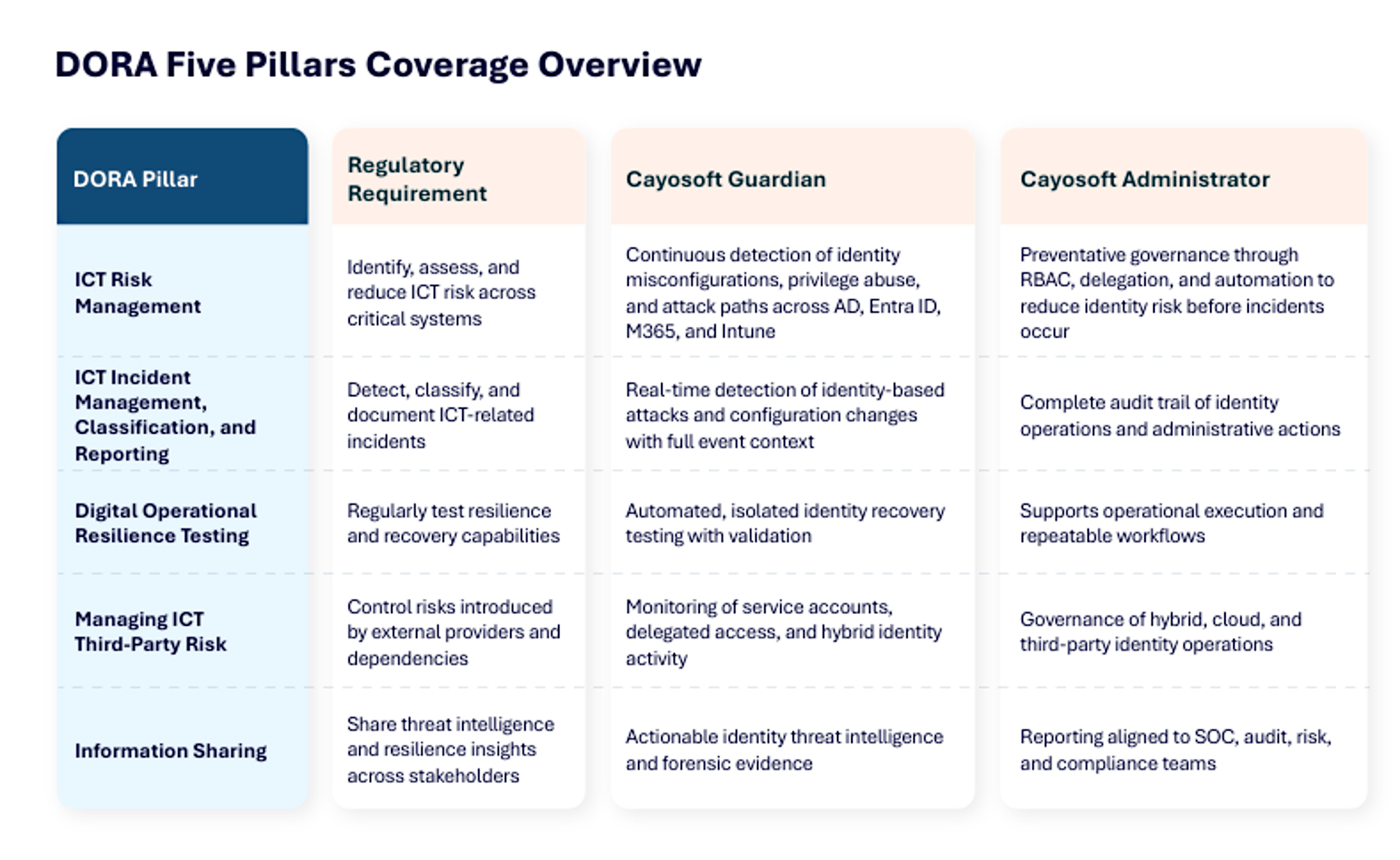
Mapping Cayosoft to the Five DORA Pillars

Pillar 1: ICT Risk Management

This is where most DORA compliance programs either get stronger or stay fragile.

Risk reduction is not the same thing as risk visibility.

If you still have broad standing privilege in identity platforms, you have accepted the most common failure mode.

Cayosoft Administrator reduces identity risk before incidents occur by enforcing role-based access, controlled delegation, and policy-driven automation.

Cayosoft Guardian continuously detects misconfigurations, privilege abuse, and emerging attack paths across Active Directory, Entra ID, Microsoft 365, and Intune.

Pillar 2: Incident Management, Classification, and Reporting

Identity incidents are hard because they are fast.

A single privileged change can disable a control, grant access, or break a business service.

Cayosoft Guardian detects identity-driven attacks and unauthorized configuration changes with full context.

Cayosoft Administrator maintains a complete audit trail of identity operations.

When a regulator asks what happened, you can answer with evidence.

Pillar 3: Digital Operational Resilience Testing

DORA compliance expects you to test resilience. Not once. Repeatedly.

Guardian Forest Recovery enables automated, isolated identity recovery testing with validation.

That moves recovery from a binder to an operational capability you can prove, which is exactly what DORA compliance auditors expect.

Pillar 4: Managing ICT Third-party Risk

Third-party risk is not abstract when your identity plane is hybrid.

Cloud identity dependencies, delegated access, automation identities, and service accounts all create paths into the control plane.

Cayosoft governs those access paths and monitors identity activity across hybrid and cloud platforms, including Microsoft 365 and Intune. Managing these access paths is a direct DORA compliance obligation, not a best practice.

Pillar 5: Information Sharing

DORA compliance expects coordinated decision-making across security, risk, and compliance.

Cayosoft Guardian provides identity-focused evidence and threat intelligence.

Cayosoft Administrator provides reporting aligned to audit and operational teams.

Cayosoft Administrator: Preventative Identity Governance

DORA compliance starts with risk reduction, not detection. If identity platforms are overprivileged or loosely governed, incidents are inevitable.

Cayosoft Administrator provides the preventative controls required to reduce ICT risk before an incident occurs by governing how identity changes are requested, approved, and executed across the Microsoft identity stack.

This is the layer that most DORA compliance strategies are missing.

What Administrator Actually Does

Centralized identity administration

Cayosoft Administrator provides unified management across Active Directory, Entra ID, Microsoft 365, and Intune, allowing identity teams to operate from a single control plane rather than stitching together native tools.

  • Unified management of Active Directory, Entra ID, Microsoft 365, and Intune
  • Native support for hybrid and cloud-only environments

A consistent control model across platforms

Role-based access and delegation

DORA compliance requires organizations to reduce standing privilege and clearly define who is allowed to make changes to critical systems.

Administrator enforces role-based and rule-based administration, so identity changes are performed through controlled delegation, not broad native admin roles.

  • Granular role and rule-based administration
  • Enforced least privilege without standing native admin roles
  • Segregation of duties aligned to real operational responsibilities

Automation and policy enforcement

Manual identity operations introduce drift. Drift introduces risk.

Administrator replaces ad hoc identity changes with policy-driven automation that reduces human error and keeps identity state consistent over time.

  • Automated provisioning, deprovisioning, and access changes
  • Reduced manual intervention and configuration drift
  • Policy-driven operations instead of ad hoc changes

Audit and reporting

DORA compliance depends on evidence. Administrator maintains a complete record of identity operations so organizations can demonstrate who changed what, when, and under what authority.

  • Full visibility into identity operations
  • Evidence to support compliance reviews and internal controls

Administrator directly supports DORA’s ICT risk management pillar by reducing exposure up front, rather than relying on post-incident remediation.

Cayosoft Guardian: Detection, Evidence, and Recovery

Even with strong governance, identity incidents still happen. DORA compliance requires organizations to detect them early, classify them accurately, and recover cleanly.

Cayosoft Guardian provides the detective and corrective controls required by DORA across the identity control plane.

Continuous Identity Monitoring

Guardian continuously monitors identity systems for the types of changes that disrupt operations.

  • Privilege escalation and role abuse
  • Unauthorized configuration changes
  • Persistence mechanisms used by attackers
  • Configuration drift across Active Directory, Entra ID, Microsoft 365, and Intune

This enables detection of identity-based attacks that bypass traditional endpoint and network defenses.

Change Tracking and Audit Evidence

Identity incidents move fast. Reconstruction after the fact is where most teams struggle.

Guardian records all identity-relevant changes with full context:

  • What changed
  • When it changed
  • Where it changed
  • How it changed

This creates an audit-ready record that supports incident classification, regulatory reporting, and post-incident review without guesswork.

Proving Recoverability with Guardian Instant Forest Recovery

DORA requires organizations to prove they can recover critical ICT services, not simply state that backups exist. Guardian Instant Forest Recovery delivers automated, identity-first recovery by restoring Active Directory, Entra ID, Microsoft 365, and identity-dependent services into clean, isolated recovery environments. Recovery focuses on identity state, not compromised operating systems.

Key capabilities include:

  • Isolated recovery environments to prevent reinfection
  • Automated recovery workflows to reduce manual error
  • Integrity validation to ensure attacker persistence is not reintroduced

This directly supports DORA business continuity and resilience requirements by turning recovery into a tested, repeatable capability.

From Compliance to Operational Confidence

DORA raises expectations, but it also exposes a gap. Organizations that approach DORA compliance as a reporting exercise may meet the letter of the regulation without achieving its intent. Organizations that focus on identity resilience gain something more durable.

    • Confidence that critical services remain available.
    • Confidence that identity-driven disruption is detected quickly.
    • Confidence that recovery is clean, fast, and defensible.

By combining preventative governance with Administrator, continuous detection and evidence with Guardian, and validated recovery through Guardian Instant Forest Recovery across Active Directory, Entra ID, Microsoft 365, and Intune, Cayosoft delivers full-spectrum identity resilience aligned to DORA’s five pillars.

DORA is about resilience. Identity is how you prove it.

FAQ

DORA compliance applies to more than 20 categories of financial entities operating in or with the EU, including banks, insurers, investment firms, payment service providers, and crypto-asset service providers. It also applies to critical ICT third-party providers, such as cloud platforms and data analytics firms, that serve those entities, regardless of where they are headquartered.
Non-compliance can result in fines of up to 1% of average daily global turnover, applied every day until compliance is achieved. Beyond financial penalties, organizations face increased regulatory scrutiny, potential operational restrictions, and reputational damage to clients and counterparties.
Identity is the control plane for everything DORA requires you to protect. Access governance, privileged change management, incident detection, and recovery all run through Active Directory, Entra ID, Microsoft 365, and Intune. If identity is ungoverned or unmonitored, DORA compliance cannot be demonstrated, regardless of what other controls are in place.
Yes. Guardian Instant Forest Recovery enables automated, isolated identity recovery testing with integrity validation,  which is exactly what DORA compliance auditors expect to see. Rather than pointing to a recovery binder, organizations can demonstrate a tested, repeatable capability with documented results.
Yes. Cayosoft Administrator and Guardian together address all five pillars: ICT risk management through preventative governance, incident management through real-time detection and audit evidence, resilience testing through automated forest recovery, third-party risk through identity access path monitoring, and information sharing through reporting aligned to security, risk, and compliance teams.

See Cayosoft in Action

Only Cayosoft provides immediate threat detection and rollback of unwanted changes in Intune, Entra ID. Microsoft 365 and Active Directory. All from a single pane of glass. Schedule a demo to see the capabilities in depth.