



Most disaster recovery plans are organized around servers, storage, and applications, with recovery time objectives set per system. Identity tends to be listed as one more system. In practice it sits underneath all of them: SQL Server instances and file servers running under domain service accounts still need Kerberos, administrators still need credentials that validate, and the tools running the recovery often sign in against the directory that is down.
That makes identity’s RTO the floor for every other RTO in the plan. A four-hour target for a business application means nothing if the forest takes three days. From the Gartner note:
“Restoring infrastructure provides limited value if the identity services required to support downstream recovery activities cannot be restored within business-defined timelines.”
For an AD team, the practical question is: when the incident starts, how long until a domain controller you trust is issuing Kerberos tickets again?
Rebuilding a Forest During the Incident is the Slowest Path
Traditional forest recovery is a rebuild. Microsoft’s Active Directory Forest Recovery Guide lays it out as dozens of manual steps across several phases, from restoring one writable domain controller per domain in isolation to seizing FSMO roles, invalidating the RID pool, and resetting the krbtgt account twice before more domain controllers come online. From the Gartner note:
“Forest recovery typically requires isolating compromised controllers, identifying an authoritative recovery point, validating controller health, verifying replication and reestablishing trust. These activities often rely on manual processes and operator judgment, increasing the risk of delays and errors.”
Every one of those steps happens while the business is down, often run from a recovery console or a runbook that may itself be unavailable, untested, or compromised. Legacy AD backup and recovery tools were not designed for the complexity of modern hybrid AD environments, and they often need pre-staged hardware, manual scripting, and hours or days of rebuilding.
To meet an identity-first RTO, the recovery approach has to move that work to before the incident. The forest, domain, DNS, SYSVOL, and FSMO work should already be done and validated, so that recovery during the incident is a decision to switch over, not a rebuild that starts from scratch.
Restoring a Compromised Forest Reintroduces the Attacker’s Persistence
Speed is only half the requirement. From the Gartner note:
“A key challenge is the attackers’ extended dwell time; often weeks or months from initial compromise before they launch ransomware or initiate destructive actions.”
During that time, attackers add rogue group memberships, change ACLs and AdminSDHolder, edit GPOs, and set up delegation or SIDHistory backdoors. Resetting passwords and krbtgt doesn’t remove any of these. All of it is directory state, so system-state backups, bare-metal images, and VM snapshots of domain controllers capture it along with everything legitimate. From the same note:
“Restoring from such backups will inadvertently reintroduce the original compromise.”
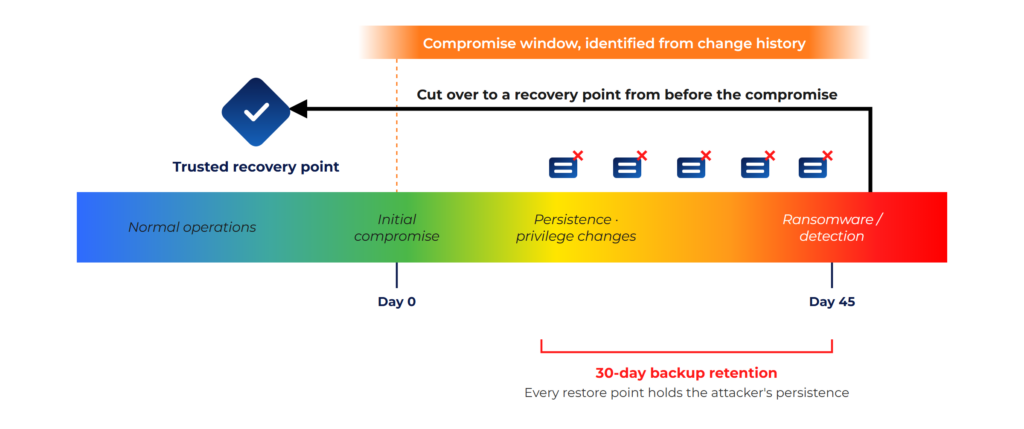
Put the dwell time next to the backup retention and the problem is easy to see. A common example: domain controller system-state backups are kept for 30 days, and the attacker’s first foothold was 45 days before the ransomware runs. Every restore point in retention holds the persistence. Longer retention helps, since an AD backup stays usable up to the tombstone lifetime, but it doesn’t solve the problem. Restoring a backup from before day 0 throws away six weeks of legitimate changes, and finding the last clean point means mounting and inspecting backups one by one in the middle of the incident.
“Because malicious changes often predate incident detection by weeks or months, recovery efforts should combine backup data with change visibility, threat investigation and recovery validation processes.”
To avoid restoring the attack, a recovery approach needs three things: a change history that shows what changed and when the compromise started, a choice of recovery points far enough back to land before it, and the ability to reverse the attacker’s individual changes without writing off the legitimate work around them. Recovery is only useful if teams know which recovery point can be trusted.
Recovery Has to Happen Outside the Systems the Attacker Reached
Attackers know how to target backups, recovery consoles, credentials, and runbooks. Recovery assets that share production identity, credentials, infrastructure, or management planes inherit the same blast radius. From the Gartner note:
“For cyber recovery, organizations should separate identity data and configuration from OS recovery, use clean OS instances and validate recovered domain controllers within isolated recovery environments (IREs) before reconnecting them to production.”
In practice, that means the recovery environment should run on clean operating systems rather than restored images, on a network with no path to or from production, administered by accounts that don’t exist in the production directory. The backups it is built from should be immutable, so an attacker with production credentials can’t alter or delete them.
Identity-First Recovery is a Readiness Discipline, Not a Backup Exercise
From the Gartner note:
“Heads of I&O should view identity recovery as an orchestration challenge rather than a backup exercise.”
A backup proves that data exists. It does not prove that the forest will come back, in what order, how quickly, or in what state. From the Gartner note:
“By 2031, 60% of organizations will maintain tested, identity-specific recovery playbooks, up from less than 20% in 2026.”
“By 2031, 65% of organizations will deploy dedicated identity backup and recovery solutions to augment native recovery capabilities, up from less than 20% in 2026.”
A playbook that is only exercised during an incident is disaster recovery theatre. The recovery environment should be validated continuously, so the team knows recovery works before the outage happens, and the result should be evidence an auditor can review.
How Cayosoft Guardian Delivers Identity-First AD Recovery
Cayosoft Guardian Instant Forest Recovery is built around one idea: the forest should already be recovered before the crisis.
Recover in minutes. Guardian pre-builds and continuously maintains a clean standby Active Directory forest, with forest, domain, DNS, SYSVOL, and FSMO recovery readiness automated at every backup. When identity fails, the team executes a controlled cutover to a validated environment. No rebuild. No backup gamble. Recovery becomes an operational decision aligned to defined RTOs. Paradigm Technica’s independent technical and economic validation found Cayosoft at least 99% faster than the closest alternative.
Restore trust, not the compromise. Guardian keeps multiple backups covering many recovery points and can maintain multiple standby forests for different points in time, so teams can cut over to a state from before the compromise began. Threat detection, change history, and forensic context show what changed and identify the compromise window, and any change Guardian records can be rolled back individually.
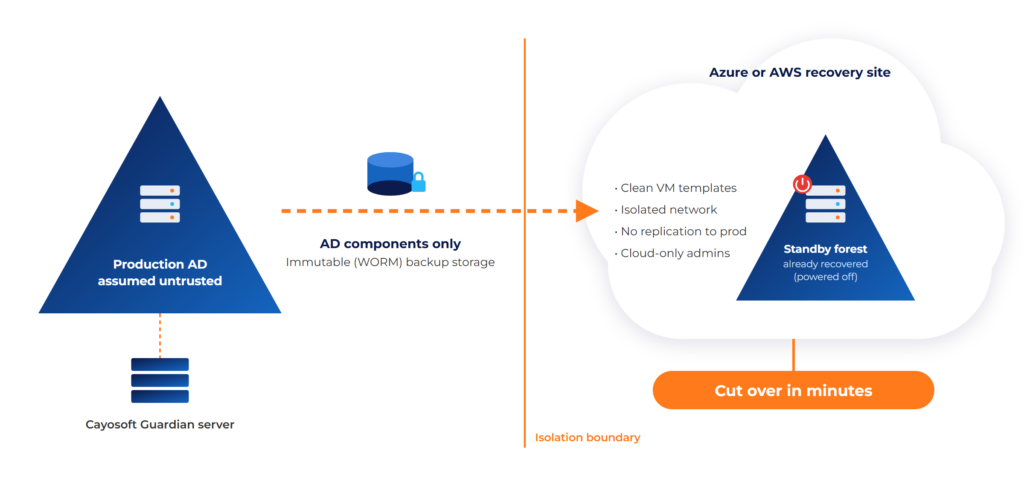
Isolate recovery. Standby forests run in Azure or AWS, on clean VM templates rather than reused operating systems or images, on isolated networks with no replication to production, managed by cloud-only administrators who share no credentials with production. Only AD components move to the recovery site. Backup storage can be made immutable with WORM, so forest recovery runs from an unaltered backup. Because the cloud-hosted standby forest operates independently, it is already recovered and ready for cutover even if the primary Cayosoft Guardian server is affected by the attack.
Validated before the crisis. Guardian replaces disaster recovery theatre with a tested, validated, operational recovery model. The standby forest is maintained and validated continuously, and every validation leaves an audit-ready record that recovery works.